

A chain-control checkpoint is the wrong place to discover that your traction devices will not clear the suspension. For 2026, diamond-pattern chains are the default choice for passenger cars that permit link chains; low-profile cables suit restricted-clearance applications, and textile devices belong only where both the vehicle manufacturer and road authority accept them.
- For snow chains for car use, choose vehicle-approved diamond-pattern chains as the default metal-chain option.
- Low-profile cable chains suit restricted-clearance applications only when the vehicle manual permits the exact device type.
- Textile snow socks require vehicle approval and acceptance under the route’s current traction-control rules.
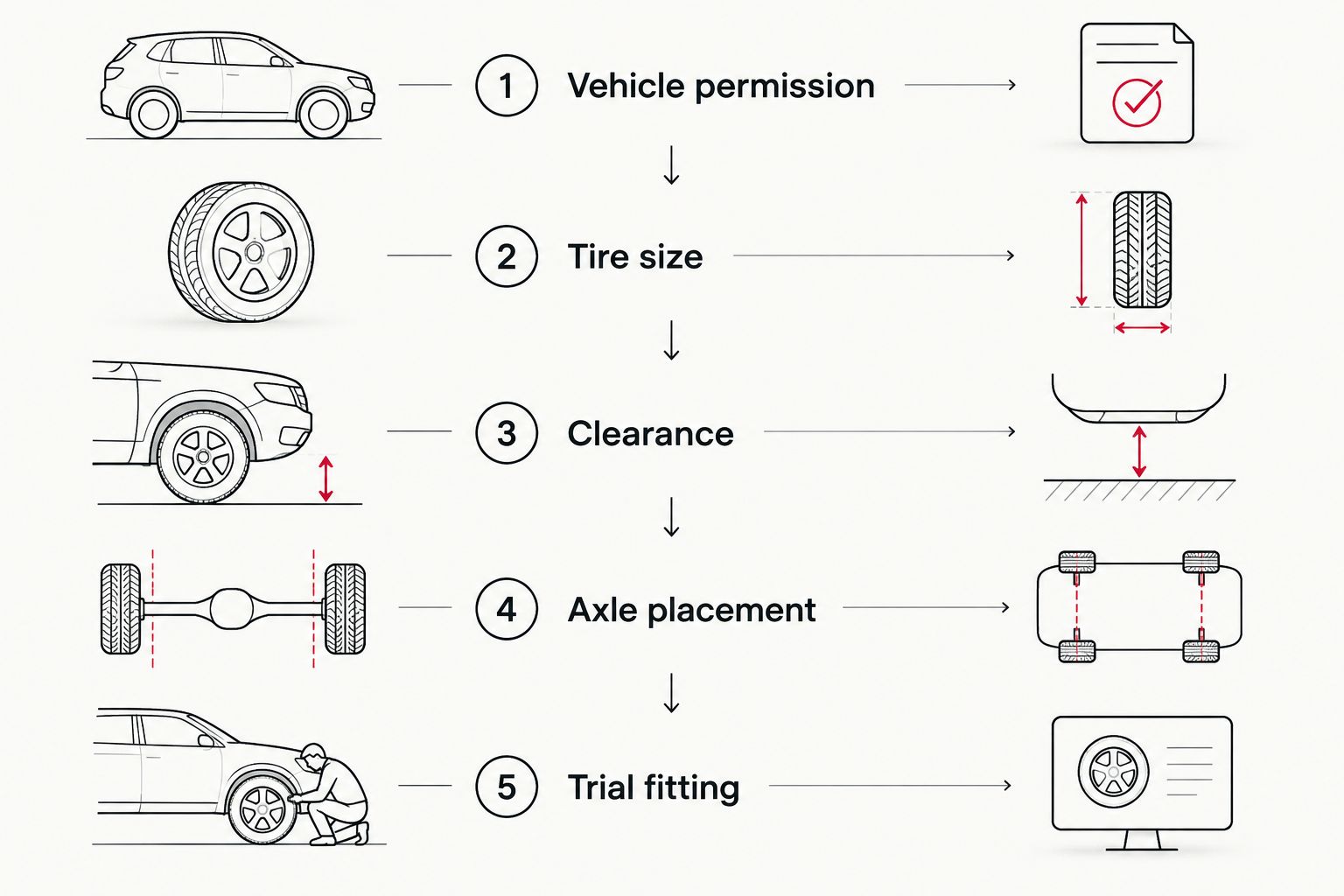
- TruckNTow’s snow-chain selection rule: confirm vehicle permission, tire size, clearance, and axle placement before choosing a pattern.
Why fit matters more than a snow-chain ranking
When a passenger car loses traction on a snowy climb, adding more throttle does not solve the underlying grip problem, and a poorly fitted chain introduces another hazard beside the tire. You need a traction device that fits the installed tire, stays centered under tension, and operates within the clearance limits specified for your vehicle.
This 2026 guide ranks traction-device designs by application rather than naming a universal product winner. The best snow chains for a car are the chains its manufacturer permits, fitted to the actual tires and installed on the specified axle. A useful pattern cannot compensate for an incompatible fit.
Passenger-car requirements also differ from truck applications; the guide to choosing tire chains for a pickup truck covers that separate selection problem. Do not transfer a pickup recommendation to a sedan because the tread widths look similar.
What makes the best passenger-car snow chains
Use these criteria before comparing designs:
- Vehicle permission: The owner’s manual must permit the device type on your installed wheel-and-tire combination.
- Exact tire fit: The manufacturer’s fit chart must list the complete tire size, not just the wheel diameter.
- Operating clearance: Check restrictions around the inner sidewall, suspension, brake components, and wheel housing.
- Retention system: Choose closures and tensioners that you can operate correctly with cold hands and gloves.
- Road acceptance: Confirm that the device satisfies the traction requirement on your planned route.
- Inspection access: Connections, cross members, and tensioning parts must remain accessible for condition checks.
Best snow-chain types at a glance
The ranking below is a decision tree for 2026 passenger-car use. Start with vehicle approval, then select the design that matches the trip; none of these categories overrides a prohibition in the owner’s manual.
| Rank and option | Best for | Standout feature | Key limitation |
|---|---|---|---|
| Diamond-pattern link chains | Cars approved for link chains on repeated snowy-road trips | Interconnected links run diagonally across the tread | Link profile and inner connections still require clearance |
| Low-profile cable chains | Cars whose manuals permit cable devices in restricted-clearance applications | Cable construction offers an alternative to conventional links | Low profile does not establish vehicle compatibility |
| Ladder-pattern link chains | Approved vehicles needing a straightforward cross-chain layout | Separate cross chains span the tire tread | Intermittent tread contact produces a different ride from diagonal patterns |
| Textile snow socks | Approved short snow-covered sections where textile devices are accepted | Fabric construction without a conventional metal cross-chain layout | Acceptance and exposed-pavement wear limit their application |
1. Diamond-pattern chains: best for repeated snowy-road trips
Diamond-pattern chains place interconnected links diagonally across the tread rather than arranging every cross member straight across it. This layout provides traction elements at different positions across the rolling tire, making it a practical starting point when your car permits conventional link chains.
Best for: Drivers making repeated snowy-road trips in passenger cars approved for the selected link profile.
Diamond-pattern chain pros:
- Diagonal links distribute traction elements across the tread.
- The pattern provides an alternative to straight ladder cross chains.
- Options with integrated tensioning simplify the adjustment process when used as instructed.
Diamond-pattern chain cons:
- Inner connections still need sufficient clearance.
- Integrated tensioning does not eliminate fit checks or inspection.
- A diamond layout alone says nothing about approval for your car.
Select the chain size from the manufacturer’s application chart, then check the exact closure and tensioning procedure before departure. Verdict: Buy diamond-pattern chains when the manual permits them and the complete assembly clears the vehicle.
2. Low-profile cable chains: best for permitted tight-clearance use
Cable chains use cable-based construction rather than a conventional all-link cross-chain arrangement. They are a candidate when the vehicle manual permits cable traction devices but restricts bulkier chain designs.
Best for: Drivers whose cars specifically permit the selected cable device within their clearance restrictions.
Cable-chain pros:
- Offer a construction alternative to conventional link chains.
- Low-profile designs address applications with clearance restrictions.
- Flexible assemblies can be laid out for inspection before installation.
Cable-chain cons:
- Cable construction does not automatically satisfy the vehicle’s restrictions.
- Connections and tensioners can occupy more space than the tread-contact elements.
- Incorrect tension allows movement that defeats the intended fit.
Read the restriction literally, including permitted tire sizes and axle placement. A retailer’s broad passenger-car label is not a substitute for the vehicle manufacturer’s instructions. Verdict: Buy low-profile cables only when the exact application is permitted; skip them when permission is unclear.
3. Ladder-pattern chains: best for a straightforward cross-chain layout
Ladder-pattern chains have side chains connected by cross chains that run across the tread. Their layout makes individual cross chains easy to identify during inspection, but the spacing creates alternating contact between the tire and the cross-chain sections.
Best for: Drivers with approved vehicle clearance who want a conventional, readily inspectable chain layout.
Ladder-pattern chain pros:
- Cross-chain connections are easy to distinguish during inspection.
- The layout makes twisted or missing cross members visible.
- Conventional construction provides a clear installation reference once correctly laid out.
Ladder-pattern chain cons:
- Straight cross chains create intermittent metal contact as the tire rolls.
- Conventional link dimensions can rule them out on restricted-clearance cars.
- A simple layout still requires correct closures and tensioning.
Do not treat heavier links as an automatic improvement for a passenger car; clearance remains the controlling requirement. Verdict: Buy ladder-pattern chains for a confirmed compatible application, not as a substitute for a specified low-profile device.
4. Textile snow socks: best for accepted short snow-covered sections
Textile snow socks cover the tire tread with a fabric traction surface instead of conventional metal cross chains. They belong in this comparison because they are an alternative traction device, not because every chain-control rule treats them as equivalent to chains.
Best for: Drivers whose vehicle permits textile devices and whose route explicitly accepts them.
Textile snow-sock pros:
- Fabric construction avoids a conventional metal cross-chain layout.
- They provide another device category to check against vehicle restrictions.
- The covering can be inspected for tears and displaced fabric.
Textile snow-sock cons:
- Acceptance varies with the governing traction-control requirement.
- Bare pavement abrades the fabric.
- Fabric devices are not permission to ignore a vehicle’s traction-device restrictions.
Check acceptance for the route before counting textile devices as your chain-control equipment. Verdict: Buy textile snow socks for a specifically approved use; skip them when the route requires a device they do not satisfy.
How the designs are ranked
The order prioritizes a useful default for approved passenger cars, then separates restricted-clearance, conventional cross-chain, and textile applications. It is a design comparison, not a measured stopping-distance test or a claim that one construction fits every vehicle.
Compatibility: check the car, tire, and axle together
For your 2026 setup, begin with the traction-device section of the owner’s manual, not a generic fit selector. Some restrictions apply only to particular wheel-and-tire combinations, so a recommendation for another trim of the same car is not enough.
Use this sequence before ordering:
- Vehicle permission: Identify permitted device types and prohibited applications.
- Tire size: Read the size from each tire that will receive a device.
- Clearance: Match the device profile and connections to the vehicle’s requirements.
- Axle placement: Follow the vehicle’s specified installation position.
- Trial fitting: Install the devices in safe conditions using their instructions.
A tire marked 205/55R16 has a nominal section width of 205 millimeters, an aspect ratio of 55 percent, and a nominal rim diameter of 16 inches. Those markings identify different dimensions; matching only the last figure does not establish chain fit.
Read the installed tires rather than assuming they match the original specification, especially after wheel changes. Staggered tire sizes also require attention because the front and rear fit applications differ.
Front-wheel drive, rear-wheel drive, and all-wheel drive do not share one universal chain-placement rule. Follow the manual, including any requirement for additional devices, and never assume that all-wheel drive either eliminates chains or permits installation on whichever axle is easiest to reach.
Safety: install before traction disappears
Choose a designated chain-up area or another safe, level location away from moving traffic, and follow the vehicle and traction-device instructions. Do not wait until the car is blocking a grade or sliding toward the shoulder before opening the storage bag.
Lay out the assemblies and identify the inner closure, outer closure, and tensioning parts before positioning them. Remove twists and verify that the specified tread-contact surfaces face the correct direction; an installation that looks roughly centered is not a completed inspection.
- Seat every connector as instructed and keep loose ends secured.
- Confirm that the assembly is centered on the tire.
- Check that no part contacts brake hoses, wiring, or suspension components.
- Perform any initial movement and retensioning required by the device manufacturer.
- Stop safely if you hear striking, feel abnormal vibration, or suspect a loose component.
Use the lower operating limit specified by the vehicle or traction-device manufacturer, and reduce speed further for the actual surface and visibility. Chains do not restore dry-road braking or make abrupt steering and acceleration safe.
For a 2026 mountain trip, check the road authority’s current restrictions before entering the controlled section. Carrying devices, installing devices, and satisfying a particular checkpoint instruction are different requirements; possession alone does not establish compliance.
Keep traction equipment separate from transport equipment
TruckNTow car tie-down equipment secures a vehicle during transport; it does not provide tire traction while that vehicle drives. Chain-anchor straps, binder chains, and recovery chains are not substitutes for purpose-built snow chains, regardless of their load ratings.
If conditions require professional transport rather than continued driving, use the vehicle manufacturer’s towing instructions. The car-hauler tie-down strap selection guide addresses that separate task without confusing securement hardware with road-traction devices.
Maintenance: inspect, dry, and practice before winter travel
After use, clean the devices according to their manufacturer’s instructions and let them dry before storage. Road residue trapped in a wet bag complicates inspection and exposes metal components to corrosion.
Inspect link connections, cables, closures, tensioners, and fabric surfaces as applicable. Remove damaged devices from service rather than improvising repairs, substituting hardware, or relying on a tensioner to compensate for a broken component.
- Metal links: Look for cracks, deformation, and wear at contact points.
- Cable assemblies: Check for broken strands and damaged traction elements.
- Closures: Confirm that moving parts engage correctly without forcing them.
- Textile devices: Inspect for tears, holes, and damaged retaining sections.
- Storage: Keep matched devices, instructions, and required accessories together.
Practice installation with the gloves you carry in the car, and include removal in the rehearsal. A dry trial exposes confusing connections before darkness, slush, and traffic make the job harder.
Which snow-chain type should you choose?
Choose a vehicle-approved diamond-pattern chain as your default, select cables when the manual requires a compatible low-profile solution, and choose textile devices only for explicitly accepted applications. Ladder-pattern chains remain an option where their construction fits the vehicle’s requirements.
TruckNTow’s snow-chain recommendation for 2026 starts with compatibility rather than link size or a heavy-duty label. Do not buy until you can match the vehicle restriction, installed tire size, permitted axle, and device instructions.
FAQ
What’s the best snow-chain type for a passenger car?
A vehicle-approved diamond-pattern chain is a practical default for a passenger car that permits link chains. Choose a different design when the owner’s manual specifies a restricted-clearance device or prohibits conventional chains.
Can I put snow chains on any car?
No, snow chains are not permitted on every car or wheel-and-tire combination. Check the owner’s manual for device restrictions, approved tire sizes, and installation positions before selecting a set.
Are cable chains better than link chains for a car?
Cable chains are the better choice when they satisfy a vehicle’s specific clearance restrictions and conventional links do not. Construction alone does not establish compatibility, so check the complete assembly against the vehicle instructions.
Do snow chains go on the front or rear tires?
Install snow chains on the axle specified by the vehicle manufacturer. Do not choose placement solely from a general front-wheel-drive, rear-wheel-drive, or all-wheel-drive rule when the manual gives specific instructions.
Do all-wheel-drive cars still need snow chains?
All-wheel-drive cars still need permitted traction devices when the applicable road restriction requires them. All-wheel drive does not override chain-control instructions or the vehicle’s installation restrictions.
Are snow socks accepted instead of chains?
Snow socks are accepted only where the governing road authority recognizes the particular device for the applicable restriction. Confirm vehicle compatibility and route acceptance before relying on textile devices.
Can I use a tow chain as a snow chain?
No, a tow chain is not a tire traction device. Use a purpose-built traction assembly sized for the tire and permitted by the vehicle manufacturer.
Can I keep snow chains installed on dry pavement?
Remove snow chains when they are no longer required by the surface conditions and road instructions, following the device manufacturer’s guidance. Driving on exposed pavement increases wear and can damage the traction assembly.
One last thing
A chain can match the tire-size chart and still be prohibited on the car carrying that tire. Complete the manual check and trial fitting before departure, not after a checkpoint attendant directs you into the chain-up area.
Related guides
For separate towing and vehicle-securement tasks, shop the full line at TruckNTow. Prepare before the weather closes in, and put correctly matched equipment to work with confidence.