

When you're checking a tractor-trailer before another long-haul run, the best semi truck accessories are the ones that help you find a problem, maintain visibility, and secure the freight correctly. Best overall: a dual-angle tire gauge; best for cold-weather visibility: a heated truck mirror; best for flatbed freight: properly matched winch straps.
- The best semi truck accessories start with a dual-angle tire gauge, then equipment matched to your trailer and freight.
- TruckNTow offers trucking accessories for drivers who need inspection tools, replacement mirrors, and cargo-control equipment.
- Choose heated mirrors for defrosting and convex mirrors for wider blind-spot coverage; they serve different jobs.
- Buy winch straps and chain binders by working load limit and fit, not appearance.
Why these accessories matter on a long-haul run
A long-haul accessory earns its place when it addresses an actual inspection, visibility, or securement task, rather than adding another item to the cab. This 2026 guide separates general tractor equipment from trailer-specific purchases, so you don't treat a flatbed binder as an essential accessory for a dry-van assignment.
TruckNTow is a fit for long-haul drivers shopping for practical semi truck accessories and cargo-control equipment. The TruckNTow catalog covers trucking and towing accessories, but your equipment list should follow the tractor, trailer, and freight you operate.
What makes the best semi truck accessories
- Task relevance: Choose equipment that addresses a recurring job, such as checking pressure, clearing a mirror, or tensioning a tiedown.
- Physical compatibility: Match mounting points, valve access, trailer winches, chain size, and usable reach before ordering.
- Readable specifications: Distinguish dimensions and working load limits from claims that don't tell you whether an item fits.
- Inspection access: Favor equipment you can check before departure without dismantling the installation.
- Service requirements: Account for cleaning, electrical connections, moving parts, and dry storage when building your kit.
Semi truck accessories at a glance
The ranking below prioritizes broad usefulness first, then specific hauling assignments. A lower-ranked accessory is still the right purchase when its task matches your work; a height stick belongs ahead of replacement mirrors when measuring loaded height is the immediate requirement.
| Accessory | Best for | Standout feature | Key limitation |
|---|---|---|---|
| Truck Dual Angle Head Tire Gauge | Routine pressure checks | 120 psi range and retained reading | Requires valve access; does not inflate tires |
| Truck Mirror Angle Back — Stainless Heated | Cold-weather mirror defrosting | Heated mirror measuring 7 inches x 16 inches | Requires compatible mounting and electrical supply |
| Truck Mirror Convex — Center Stud — Stainless | Supplemental blind-spot coverage | Convex glass and 8.5-inch diameter | Distorts apparent distance |
| Buyers Polymer Mud Flaps — Black | Replacing damaged rear splash protection | 24-inch x 30-inch size and 3/16-inch construction | Dimensions alone do not establish installation fit |
| VULCAN Folding Handle Ratchet Binder | Chain-secured flatbed loads | Folding handle; specified chain-size range | Must match the complete chain securement system |
| VULCAN Winch Strap With Flat Hook | Freight on winch-equipped flatbeds | 4-inch x 27-foot webbing; 5,000-pound safe working load | Requires compatible winches, anchors, and edge protection |
| Quickclick Compact Plus Load Height Measuring Stick | Checking loaded vehicle height | Measures up to 15 feet | Does not establish route clearance |
Ranked picks for inspection, visibility, and hauling
1. Dual-angle tire gauge: best for routine pressure checks
The Truck Dual Angle Head Tire Gauge measures tire pressure, and its locking metal inner core retains the reading after you remove the gauge from the valve. The stated 120 psi range describes the tool, not the correct inflation pressure for every tire on your combination.
For a 2026 long-haul kit, this is the default first pick because pressure measurement applies across trailer assignments. Confirm the gauge head reaches your valve stems, including the access available around dual wheels.
Dual-angle tire gauge pros:
- Measures pressure rather than relying on appearance or sound.
- Retains the reading after removal.
- Uses a dual-angle head for different valve approaches.
Dual-angle tire gauge cons:
- Does not add air or repair a leak.
- Requires adequate valve access and a sound valve connection.
Best for: Drivers conducting routine tractor and trailer pressure checks. Buy when the range and head configuration match your tires.
2. Heated truck mirror: best for cold-weather defrosting
The Truck Mirror 7 Inch x 16 Inch Angle Back — Stainless Heated uses heating to help defrost the mirror surface. Its description also identifies stainless construction and an outer gasket for edge shock protection.
Choose this mirror when defrosting is the task, rather than assuming any stainless replacement mirror provides heat. Installation involves both the mirror mount and the electrical connection, so compare those requirements with the existing assembly before removing it.
Heated truck mirror pros:
- Provides a heating function for defrosting.
- Has stated dimensions for checking the replacement envelope.
- Includes an outer edge-protection gasket.
Heated truck mirror cons:
- Requires a compatible electrical supply and installation.
- Heating does not remove the need to clean road film from the glass.
Best for: Drivers replacing a mirror where cold-weather defrosting is required. Buy after verifying mounting and electrical compatibility.
3. Convex center-stud mirror: best for supplemental blind-spot coverage
The Truck Mirror 8.5 Inch Convex — Center Stud — Stainless is described specifically for blind-spot viewing. Convex glass provides a wider view, while making objects appear smaller and changing the apparent distance compared with a flat mirror.
Treat this mirror as a supplement to your main rearward view, not a substitute for it. Position the assembly from the normal driving seat, because a mounting location that looks suitable from outside the cab doesn't establish useful coverage.
Convex truck mirror pros:
- Provides a wider viewing field through convex glass.
- Has a specified center-stud mounting arrangement.
- Gives you an 8.5-inch diameter to check against the mounting space.
Convex truck mirror cons:
- Changes apparent size and distance.
- Requires careful positioning to cover the intended area.
Best for: Drivers addressing a specific blind spot in the existing mirror layout. Buy for supplemental coverage; skip as a replacement for the required main mirror.
4. Polymer mud flaps: best for replacing damaged splash protection
The Buyers Polymer Mud Flaps for Big Rigs and Semi Trucks — 24 Inch x 30 Inch — Black use heavy-duty polymer with stated 3/16-inch construction. The description identifies a flexible, low-density polymer material.
Measure the installed position rather than choosing length from appearance, because a flap must fit the hanger and maintain clearance around moving components. For a 2026 replacement, check the existing mounting pattern and applicable operating requirements before choosing the dimensions.
Polymer mud flap pros:
- Provides stated width, length, and thickness.
- Uses flexible polymer construction.
- Gives you a replacement option specifically named for big rigs and semi trucks.
Polymer mud flap cons:
- A matching overall size does not prove mounting-hole compatibility.
- Incorrect placement creates clearance or coverage problems.
Best for: Drivers replacing missing, torn, or unsuitable rear mud flaps. Buy after measuring the installation, not simply matching the color.
The following TruckNTow semi truck accessories support inspection and visibility work, with a mud flap option for a measured replacement installation. Choose by the task and fit checks above; these are separate tools, not interchangeable upgrades.


5. Folding-handle ratchet binder: best for chain-secured loads
The VULCAN Folding Handle Ratchet Binder tensions a compatible transport-chain assembly through a ratchet mechanism. The listed version identifies a 7,100-pound safe working load and a chain-size range of 5/16 inch to 3/8 inch.
A binder's rating does not increase the rating of the chain, hooks, or trailer anchors attached to it. Confirm the full assembly before choosing this binder for equipment or other chain-secured freight.
VULCAN ratchet binder pros:
- Uses ratchet adjustment to tension the chain.
- Identifies a working-load figure.
- States the chain-size range for selection.
VULCAN ratchet binder cons:
- Requires compatible chain and connection hardware.
- Adds moving parts that need inspection and maintenance.
Best for: Flatbed drivers whose securement plan calls for transport chain. Buy only after checking chain size, grade, and system ratings.
6. Flat-hook winch strap: best for winch-equipped flatbeds
The VULCAN Winch Strap With Flat Hook measures 4 inches x 27 feet and carries a listed 5,000-pound safe working load. It belongs on a trailer with a compatible winch and a suitable connection for the flat hook.
Select the strap length around the actual freight and routing, while checking that the hook seats correctly at the anchor. Protect webbing from sharp or abrasive load edges; tension alone does not make an unsuitable routing safe.
VULCAN winch strap pros:
- Provides specified width and length.
- Identifies a safe working load.
- Uses a defined flat-hook connection.
VULCAN winch strap cons:
- Requires compatible trailer hardware.
- Webbing needs protection from damaging edges.
Best for: Drivers securing appropriate freight on winch-equipped flatbeds. Buy when the trailer hardware and load plan match; skip for unsupported attachment arrangements.
7. Load height measuring stick: best for checking tall freight
The Quickclick Compact Plus Load Height Measuring Stick measures up to 15 feet. It gives you a tool for checking the loaded combination rather than estimating height from the freight dimensions alone.
Measured height is an input to route planning, not permission to pass under a structure. Record the result in the loaded travel configuration and compare it with the applicable route and permit requirements.
Quickclick height stick pros:
- Provides a stated measuring reach.
- Supports direct measurement of loaded height.
- Addresses a specific tall-freight planning task.
Quickclick height stick cons:
- Does not verify overhead clearance along the route.
- Requires safe access and correct measurement technique.
Best for: Drivers hauling freight that requires a loaded-height check. Buy for that assignment; hold if your work does not require it.
Compatibility checks before you order
For your 2026 equipment list, separate valve access, mirror mounting, electrical supply, and trailer hardware into distinct checks. A product can match the advertised vehicle category while still failing at the connection you need to use.
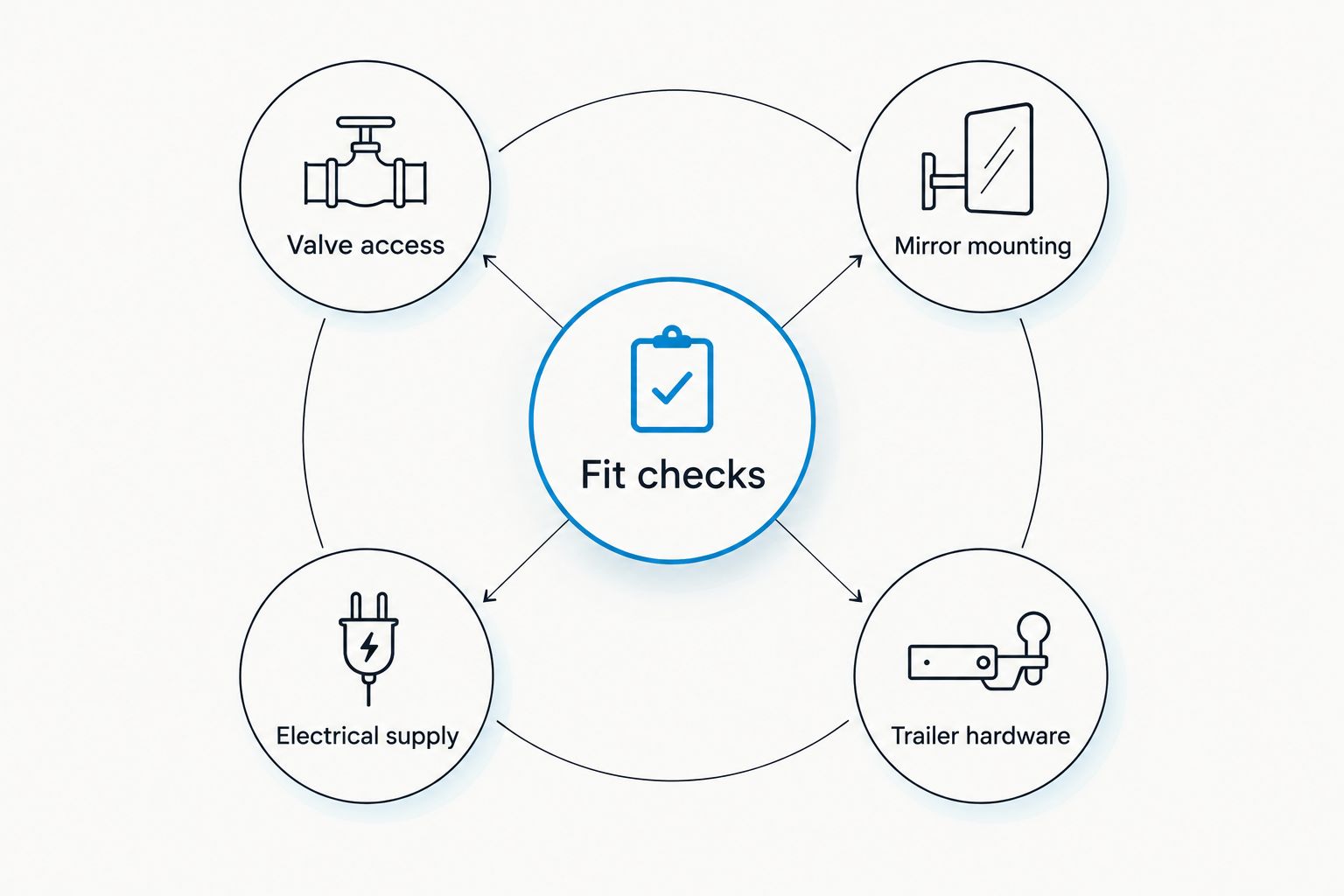
Before ordering, photograph the existing mount or connection and record the relevant measurements, because memory is a poor substitute for a hole pattern or hook interface. For mirrors, include the mount and wiring; for cargo equipment, include the winch, anchor, chain markings, and load routing.
How this ranking works: Task relevance sets the order, while fit, stated specifications, inspection access, and maintenance requirements determine each recommendation. The ranking separates accessory functions rather than claiming a field-test result or declaring one product universally suitable.
Safety and maintenance between runs
Inspection remains part of the job after the accessory is installed. During your 2026 checks, look for loose mirror mounts, damaged wiring, torn mud flaps, worn webbing, distorted hooks, and binder components that do not move or engage correctly.
- Tire gauge: Keep the head clean and protect the tool from damage; investigate inconsistent readings rather than assuming the tire changed pressure.
- Mirrors: Clean the glass, check mounting security, and confirm the intended view from the driver's seat.
- Mud flaps: Check attachments and clearance, including signs of rubbing or tearing.
- Securement equipment: Follow manufacturer removal-from-service criteria and keep damaged components out of the usable kit.
- Height stick: Check condition and operation, then store it where it will not be bent or struck by loose equipment.
Store webbing clean and dry, and maintain binder mechanisms according to their instructions. A spare only counts as usable equipment when you have inspected it; moving a damaged strap into the backup compartment does not restore its rating.
FAQ
What's the best semi truck accessory to buy first?
A dual-angle tire gauge is the default first pick for routine pressure checks. Choose a range and head configuration that match your tires and valve access; the gauge does not replace tire inspection.
Is a heated truck mirror better than a convex mirror?
A heated mirror is better for defrosting, while a convex mirror serves wider blind-spot coverage. They address different tasks, and a convex mirror changes apparent size and distance.
Does a 120 psi tire gauge mean I should inflate my tires to 120 psi?
No; 120 psi describes the stated gauge range, not a universal tire inflation target. Use the applicable tire and vehicle guidance for the load and operating conditions.
Will 24-inch x 30-inch mud flaps fit any semi truck?
No; overall dimensions do not establish mounting compatibility or correct installed clearance. Check the hanger, mounting pattern, moving components, and applicable requirements before ordering.
Can I use a chain binder with any transport chain?
No; the binder must match the chain size and the securement system's ratings. A higher-rated binder does not increase the capacity of a lower-rated chain, hook, or anchor.
Does a load height stick prove that my route is clear?
No; a height stick measures the loaded combination but does not establish route clearance. Use the measurement with route information and applicable permit requirements.
Which TruckNTow accessories suit a dry-van driver?
Inspection tools, compatible replacement mirrors, and correctly fitted mud flaps suit general tractor work. Flatbed winch straps and chain binders belong on the list only when the hauling assignment requires them.
Which semi truck accessories should you choose?
Start your 2026 kit with the dual-angle tire gauge, then address the specific visibility or hauling task your equipment requires. Choose the heated mirror for defrosting, the convex mirror for supplemental coverage, and the mud flap by measured installation fit; add binders, winch straps, and a height stick only for the assignments they support.
One last thing: a tool's maximum reading and a securement component's working load limit describe different kinds of limits, and neither tells you the correct setup by itself. Keep the relevant instructions with your equipment so the next inspection starts with the specification, not an assumption.
Shop the relevant TruckNTow equipment after completing your fit checks. Replace damaged equipment before the next run, and leave with a kit matched to the work.