

When a loaded truck is parked for unloading or service, the best rubber wheel chocks are the ones with documented suitability for its tire diameter, loaded weight, and parking surface—not simply the biggest-looking wedges. Best default for your 2026 buying shortlist: a rated molded rubber wedge; best for frequent handling: a rated handled chock; best for keeping a set together: a rope-connected pair, provided each chock meets the application requirements.
- The best rubber wheel chocks match tire diameter, loaded vehicle weight, surface conditions, and manufacturer instructions.
- A rated molded rubber wedge is the default shortlist choice for truck parking, not a universal fit.
- Handled chocks suit repeated deployment; rope-connected pairs help keep equipment together but do not increase capacity.
- TruckNTow truck equipment buyers should treat wheel chocks and transport tie-downs as separate safety systems.
What makes the best rubber wheel chocks
Why this matters on a working truck
A chock works between the tire and the ground, so its usefulness depends on both contact surfaces and the force trying to move the vehicle. Rubber construction alone does not establish suitability for a loaded truck, and a label such as heavy duty does not replace application instructions.
For tractor-trailer applications, start with the specific considerations in the guide to wheel chocks for semi trucks and big rigs. Keep the actual tire size and operating conditions in front of you while reviewing equipment; choosing from a photograph leaves the most important compatibility questions unanswered.
Use these criteria for your 2026 shortlist before comparing handles, connecting ropes, or storage convenience:
- Documented application: Require manufacturer guidance covering the vehicle and intended use, rather than treating marketing descriptions as ratings.
- Tire fit: Check the stated tire-diameter range and chock profile against the tire being restrained.
- Loaded weight: Confirm what the stated weight limit describes and the conditions attached to it.
- Ground contact: Match the manufacturer's surface guidance to the parking area, including contamination and unevenness.
- Deployment access: Choose a design you can position and retrieve without entering the vehicle's potential travel path.
- Inspection and storage: Favor equipment you can inspect completely and carry securely between jobs.
Rubber wheel chock options at a glance
These are design categories, not interchangeable capacity classes. The order below prioritizes verified fit first, handling convenience second, and compact storage last; no design earns a truck recommendation without suitable manufacturer documentation.
| Rubber chock design | Best for | Standout feature | Key limitation |
|---|---|---|---|
| Rated molded rubber wedge | A default truck-parking shortlist | Direct wedge geometry without added handling accessories | Material and appearance do not establish truck suitability |
| Rated rubber chock with a handle | Frequent deployment and retrieval | Dedicated gripping point | Handle access does not make an unsafe position safe |
| Rated rope-connected rubber pair | Keeping a designated set together | Physical connection between chocks | Rope does not add holding capacity |
| Rated compact rubber wedge | Space-limited storage for a verified application | Smaller storage footprint | Compact dimensions can exclude larger truck tires |
1. Rated molded rubber wedge: best default shortlist choice
A molded rubber wedge places an inclined face against the tire and a base against the parking surface. It is the simplest design to assess because the critical questions remain visible: does the profile fit the tire, does the base sit properly, and do the instructions cover the vehicle and conditions?
Rated molded rubber wedge pros:
- Simple geometry lets you inspect the tire-contact face and base directly.
- No connecting accessory determines where you can place the individual chock.
- A straightforward shape keeps attention on fit rather than extra features.
Rated molded rubber wedge cons:
- Rubber construction does not establish a vehicle-weight limit.
- A wedge without a dedicated grip requires a safe retrieval method.
- Similar-looking wedges can have different application restrictions.
Best for: Operators building a shortlist for truck parking who prioritize documented compatibility over added features. Verdict: Buy only when the manufacturer's instructions cover your truck and parking conditions.
2. Rated rubber chock with a handle: best for repeated deployment
A handled rubber chock adds a gripping point to the wheel-blocking body, which gives you a defined place to hold the equipment during placement and retrieval. The handle is a handling feature, not evidence of greater restraint capability, and its location needs to remain accessible in your approved setup.
Rated handled rubber chock pros:
- Provides a dedicated grip instead of requiring you to grasp the wedge body.
- Gives operators a consistent handling point during routine deployment.
- Makes handle condition a visible part of the equipment inspection.
Rated handled rubber chock cons:
- A damaged attachment can make retrieval difficult.
- A reachable handle does not justify standing in a potential roll path.
- Added hardware requires inspection alongside the rubber body.
Best for: Drivers or yard personnel placing and collecting chocks repeatedly during a shift. Verdict: Buy when both the chock application and handle access fit your procedure.
3. Rated rope-connected rubber pair: best for keeping a set together
A rope-connected pair links individual chocks so the designated set stays together during handling and storage. Each chock still needs to be positioned according to its instructions; the connection is not a brake, restraint strap, or reason to accept an unsuitable wedge.
Rated rope-connected rubber pair pros:
- Keeps the designated chocks physically associated.
- Makes it easier to identify whether the stored set is complete.
- Provides an organized way to carry the set when the manufacturer permits it.
Rated rope-connected rubber pair cons:
- Rope length can restrict placement if the required positions are too far apart.
- A loose connecting rope creates a snag or trip concern.
- The connection does not increase either chock's holding capability.
Best for: Fleets that want designated chocks stored together without confusing the connecting rope with restraint equipment. Verdict: Buy only when the connection allows every required placement.
4. Rated compact rubber wedge: best for restricted storage space
A compact rubber wedge reduces the space occupied in a compartment, but storage convenience comes after tire and vehicle compatibility. Do not move a small chock from a lighter vehicle to a larger truck merely because it is already on board.
Rated compact rubber wedge pros:
- Uses a smaller storage footprint than a larger-profile wedge.
- Fits an equipment plan where compartment space is restricted.
- Keeps the same basic inspection points as other wedge designs.
Rated compact rubber wedge cons:
- A smaller profile is not automatically suitable for a larger tire.
- A convenient fit in the toolbox says nothing about loaded-vehicle suitability.
- Its application range can rule it out for mixed truck fleets.
Best for: A specific, documented vehicle application where a compact design meets all requirements. Verdict: Skip for general truck use unless compatibility is confirmed.
How the designs rank
For 2026 purchasing, a rated molded rubber wedge is the default because it puts application suitability ahead of handling accessories. A handle or connecting rope earns its place when it solves an actual deployment problem without compromising required positioning; compact size ranks last because saving compartment space cannot compensate for unsuitable tire fit.
Compatibility: match the chock to the truck and the ground
Start with the vehicle as it operates, not just the empty truck in the yard. Record the loaded weight relevant to the manufacturer's guidance, the tire diameter, the parking surface, and the intended task, then check every limit against the chock instructions.
Read capacity wording carefully because a vehicle-weight statement is not necessarily a per-wheel load rating. Do not divide a loaded truck's weight by its tire count and use that calculation to select a chock unless the manufacturer explicitly instructs you to do so.
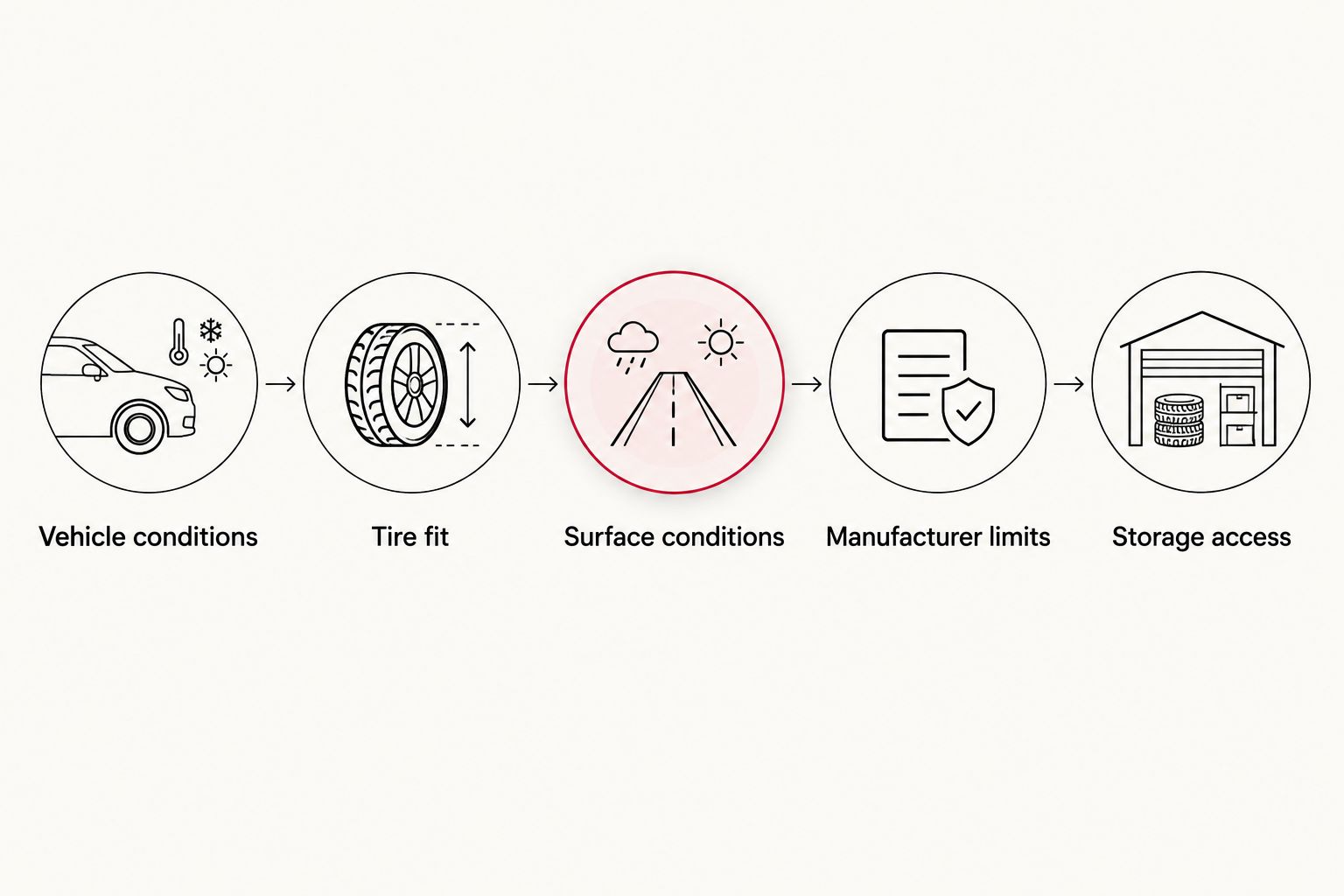
Use an application-first selection sequence
- Vehicle conditions: Identify the truck, load state, and work being performed.
- Tire fit: Verify the actual tire dimensions against the permitted application.
- Surface conditions: Assess firmness, contact area, contamination, and grade.
- Manufacturer limits: Confirm the approved placement and operating restrictions.
- Storage access: Check that the selected equipment remains accessible before work starts.
A sound base needs appropriate support from the ground underneath it, so a chock that sits correctly on firm pavement does not automatically suit loose gravel, mud, or a damaged shoulder. Ice and oil also change the contact conditions; move to a suitable parking location or use the approved alternative procedure instead of assuming rubber will grip.
For TruckNTow rubber wheel chock readers planning a 2026 fleet equipment review, standardize by verified application rather than appearance. A shared chock design is useful only if its instructions cover every vehicle and parking condition where the fleet intends to deploy it.
Safety: position chocks without substituting them for brakes
Wheel chocks supplement an approved parking and immobilization procedure; they do not replace functioning brakes or make an unsuitable work location acceptable. Apply the vehicle manufacturer's parking instructions and your site's procedures before placing equipment, and keep personnel out of the potential travel path throughout deployment.
Chock location depends on the vehicle, expected movement, ground conditions, and manufacturer instructions, so a universal placement rule is not sufficient for every truck. On a grade, the direction of potential movement matters, but downhill placement alone does not establish that the overall setup is safe.
Checks before unloading or service
- Confirm the truck is parked and secured according to the applicable procedure.
- Inspect the selected chocks for damage and verify their application suitability.
- Check that the ground supports the base without rocking or unstable contact.
- Position the chocks snugly as directed, without placing yourself in a roll path.
- Confirm the deployment with everyone involved before unloading or service begins.
- Remove and stow equipment only after the task is complete and departure is authorized.
Do not test chocks by deliberately allowing a truck to roll against them. If a chock shifts, the vehicle moves, or contact appears unstable, stop the work and reassess the location and equipment through the approved procedure.
TruckNTow truck equipment buyers should also keep parking restraint separate from vehicle transport securement. A chock blocks rolling at a parked wheel; it does not replace the correctly selected straps, chains, anchors, and procedures needed to secure a vehicle for transport.
For a 2026 yard safety review, verify that the procedure addresses changes during the job, including load removal and any planned vehicle movement. Chocks should not become forgotten obstacles when the truck returns to service.
Maintenance: keep usable chocks ready for the next stop
Inspect the rubber body, tire-contact face, base, and any handle or connecting rope before use, then follow the manufacturer's cleaning and retirement instructions. Cracks, missing material, distortion, damaged attachments, or an unreadable identification mark require attention before the equipment returns to service.
Remove dirt and debris using an approved cleaning method, and do not assume a solvent is suitable just because it removes grease. Chemical compatibility depends on the material, while a clean-looking surface does not prove that a damaged chock remains usable.
Keep the storage plan practical
- Store chocks where operators can reach them before starting work.
- Secure them against movement during travel.
- Keep inspection surfaces accessible rather than burying the set under other gear.
- Separate questionable equipment from serviceable equipment immediately.
- Replace missing components according to the manufacturer's guidance.
Which rubber wheel chocks should you choose in 2026?
Choose a rated molded rubber wedge as your default shortlist, then add a handle or connected-pair format only when it improves your approved deployment routine. Reject any option whose tire fit, weight guidance, or surface restrictions do not match the job, even when its shape looks substantial.
One last thing
Inspect the parking spot as carefully as the chock, because intact equipment cannot correct unsuitable ground contact. Make location assessment part of every deployment rather than treating it as a purchasing decision made once.
Shop the full line at TruckNTow when organizing your trucking and towing equipment. Put the right equipment within reach before the next stop; confidence comes from verified fit, sound condition, and a repeatable procedure.
FAQ
What's the best rubber wheel chock design for a truck?
A rated molded rubber wedge is the default design to shortlist, provided its instructions cover the truck's tire diameter, loaded weight, and parking conditions. Handles and connecting ropes should solve handling needs only after application suitability is confirmed.
Can I use the same rubber wheel chocks on every truck in my fleet?
Use the same chocks across a fleet only when the manufacturer's application guidance covers every intended vehicle and operating condition. Similar tire appearance or a shared parking area does not establish compatibility.
Are rubber wheel chocks better than steel wheel chocks?
Neither material is automatically better for every truck application. Compare documented suitability, tire fit, ground conditions, handling requirements, and inspection needs rather than choosing by material alone.
How many wheel chocks does my truck need?
Use the quantity and positions specified by the chock manufacturer, vehicle instructions, and applicable site procedure. Do not treat a connected pair or a single stored wedge as proof that you have enough equipment for the job.
Can rubber wheel chocks hold a truck on a slope?
Use rubber wheel chocks on a slope only within the manufacturer's approved conditions and an appropriate vehicle immobilization procedure. If the grade or ground condition falls outside that guidance, change the location or use an approved alternative.
Does the rope between wheel chocks increase their capacity?
A connecting rope does not increase wheel-chock holding capacity. Its purpose is to keep the set associated, and its length must still permit the required placement of each chock.
Can I use wheel chocks instead of setting the parking brake?
No, wheel chocks do not replace the vehicle's approved parking-brake procedure. Apply the required parking and immobilization measures before deploying chocks or starting work.
When should I replace rubber wheel chocks?
Remove rubber wheel chocks from service when damage or condition no longer meets the manufacturer's inspection criteria. Check the body, base, tire-contact face, identification, and handling attachments before each use.