

When loose webbing gets underfoot during repeated loading, retractable ratchet straps are the best fit when their working load limit, reach, and hooks match the job; choose bolt-on designs for dedicated loading positions and portable designs for changing anchor points. Automatic rewind manages the loose strap—it does not replace ratcheting, proper attachment, or a securement inspection.
- Retractable ratchet straps manage loose webbing; the ratchet mechanism supplies tension and locks the strap.
- Bolt-on retractable straps suit dedicated loading positions, provided the mounting structure and hardware meet manufacturer requirements.
- Portable retractable straps suit changing anchor locations, but housing clearance still matters.
- TruckNTow vehicle tie-down straps are conventional alternatives; select them by attachment method, dimensions, and working load limit.
Why strap selection matters during repeated loading
A rewind mechanism addresses a specific handling problem: excess webbing that otherwise needs rolling, bundling, or securing after you tighten the load. That convenience matters during repeated loading, but it does not establish whether the strap belongs on your trailer or whether its hooks fit your anchors.
Choose the securement system first and the storage mechanism second. For vehicle transport, start with the attachment principles in this guide to choosing car hauler tie-down straps, then determine whether a retractable assembly fits the required arrangement.
For your 2026 equipment purchase, separate three decisions: how the cargo is restrained, how tension is applied, and how unused webbing is stored. A conventional strap and a retractable strap can both use a ratchet, but only the retractable design incorporates a rewind mechanism.
The same distinction applies to tire and axle securement. A general-purpose hook-ended assembly is not automatically a substitute for a vehicle-specific system, even when its webbing looks similar or its stated rating appears sufficient.
What makes the best retractable ratchet straps
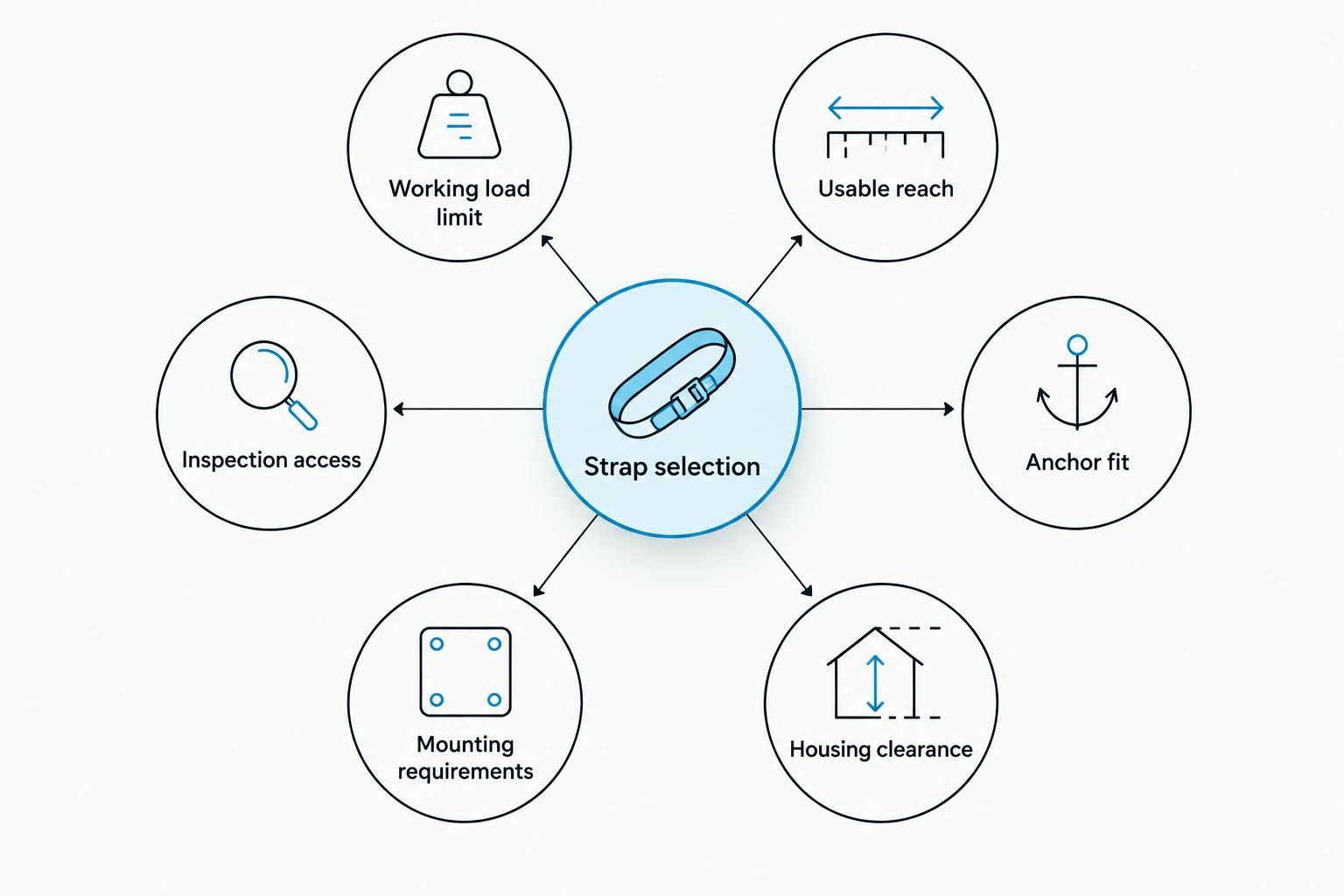
The best retractable ratchet straps match the entire securement arrangement, not just the amount of webbing you want to store. Use these criteria before comparing housings, handles, or rewind controls:
- Working load limit: Read the assembly label and manufacturer instructions; breaking strength is not the allowable working load.
- Usable reach: Measure the actual routed distance between attachment points, including the path over or around the cargo.
- Anchor fit: Match hook shape, opening, and seating position to the anchor, without tip loading or interference.
- Housing clearance: Leave room for the reel body, ratchet handle, release control, and your gloved hand throughout operation.
- Mounting requirements: Confirm whether the assembly is portable or permanently mounted, and follow the specified installation method.
- Inspection access: Choose an arrangement that lets you examine the webbing, stitching, hooks, ratchet, and mounting hardware.
These criteria work together. Adequate reach does not correct an incompatible hook, and a substantial-looking mounting bracket does not prove that the trailer structure can carry the applied force.
Inspect the release sequence before choosing a design, because controls need to remain accessible after the cargo is loaded and the strap is tensioned. A mechanism positioned behind a tire, against a rail, or underneath projecting equipment creates an operating problem that automatic rewind cannot solve.
For repeat routes, record the required reach and fitting type with the trailer's equipment list. That gives replacement purchases a functional specification instead of relying on the appearance of the previous strap.
Compatibility: the best configurations for different jobs
For a 2026 shortlist, rank the configurations by your loading pattern rather than treating every ratchet assembly as interchangeable. The comparison below separates actual retractable designs from a conventional vehicle-securement alternative.
Strap configurations at a glance
| Option | Best for | Standout feature | Key limitation |
|---|---|---|---|
| Bolt-on retractable ratchet straps | Dedicated loading positions | Rewind assembly stays at its installed position | Requires suitable structure, mounting hardware, and clearance |
| Portable retractable ratchet straps | Changing anchor locations | Rewind mechanism travels with the assembly | Housing must fit each securement location |
| VULCAN PROSeries axle tie-down combo strap | Compatible axle-securement applications | Combines axle attachment with a snap-hook ratchet | Conventional design, not a retractable strap |
1. Bolt-on retractable straps: best for dedicated loading positions
Bolt-on retractable ratchet straps keep the rewind assembly at a fixed mounting location, which suits a trailer that repeatedly carries cargo in the same position. The installed location determines the available strap path, so mounting position and cargo geometry need to be considered together.
Bolt-on retractable strap pros:
- The assembly stays with its dedicated loading position.
- The reel stores unused webbing when operated as instructed.
- A fixed location provides a consistent starting point for repeated setups.
Bolt-on retractable strap cons:
- Installation requires manufacturer-specified hardware and suitable supporting structure.
- A mounting position that fits one load can interfere with another.
- The housing and mounting connection add inspection points.
Best for: Operators securing repeat loads from established attachment positions.
Before installation, check the full operating envelope rather than only the footprint of the bracket. The handle needs room to move, the strap needs a clear exit path, and the loaded webbing must follow the direction permitted by the manufacturer.
Verdict: Buy a bolt-on design for a dedicated position only after confirming mounting suitability and operating clearance.
2. Portable retractable straps: best for changing anchor locations
Portable retractable ratchet straps combine movable attachment points with an integrated rewind mechanism, allowing you to place the assembly where the current load requires it. Unlike a permanently mounted design, the complete unit is removed and stored between assignments.
Portable retractable strap pros:
- The assembly moves between compatible anchor locations.
- Installation does not depend on leaving a reel permanently attached.
- Integrated rewind gathers unused webbing for storage.
Portable retractable strap cons:
- The housing still needs clearance at every new position.
- Hook compatibility must be checked on each trailer or load.
- Portability does not make a general-purpose assembly suitable for every cargo type.
Best for: Operators whose loading arrangements change and who need movable securement equipment.
Position the assembly before tightening, then check whether the body bears against the cargo or trailer in a way the manufacturer prohibits. If the housing prevents the hook from seating correctly, choose another approved arrangement rather than forcing the connection.
Verdict: Buy a portable design when changing anchor positions make permanent mounting impractical.
3. VULCAN PROSeries axle combo: best for compatible axle securement
The VULCAN Axle Tie Down Combo Strap with Snap Hook Ratchet is a conventional vehicle-securement option, not a retractable model. The listed PROSeries configuration measures 2 inches x 114 inches, comes in a 4-pack, and carries a stated 3,300-pound safe working load.
VULCAN PROSeries axle combo pros:
- The combo design provides an axle attachment arrangement.
- The configuration includes a snap-hook ratchet.
- Listed dimensions and safe working load provide specific selection information.
VULCAN PROSeries axle combo cons:
- It does not provide automatic webbing rewind.
- Axle routing requires clearance from vulnerable vehicle components.
- The stated strap rating does not establish the capacity of the complete trailer securement arrangement.
Best for: Vehicle haulers using a compatible, approved axle-securement method.
TruckNTow vehicle tie-down straps suit haulers choosing equipment by axle attachment, hook compatibility, and rated capacity rather than automatic rewind. Confirm the vehicle's approved securement locations before routing an axle strap, and keep webbing away from brake lines, wiring, sharp edges, and hot components.
Verdict: Buy the VULCAN PROSeries axle combo for a compatible axle-securement job; skip it if automatic retraction is a requirement.
How these configurations are ranked
The order follows loading pattern, mounting requirements, and attachment compatibility, with working load limit and reach acting as selection requirements throughout. It is a fit-based ranking, not a claim that one rewind mechanism outperforms another or that a conventional vehicle strap is retractable.
For 2026 purchasing, put the required securement method on the order specification before adding preferences such as automatic rewind. That prevents a convenient storage feature from displacing an essential attachment requirement.
Safety and maintenance: inspect beyond the rewind action
A retractable ratchet strap has two different jobs inside one assembly: the rewind system gathers webbing, while the ratchet tensions and holds it. A strap retracting normally does not prove that its ratchet, hooks, webbing, or mounting connection are safe.
Before loading
Extend the webbing for inspection according to the manufacturer's procedure, examining areas that remain hidden when the strap is stored. Look for cuts, damaged stitching, abrasion, heat damage, chemical damage, and other removal-from-service conditions identified in the instructions.
Check that the ratchet engages and releases correctly without binding, and examine hooks for deformation or damage. On a bolt-on unit, inspect the bracket, fasteners, and supporting structure rather than stopping at the reel housing.
While securing the load
Seat fittings fully in compatible anchors and keep the webbing flat along its intended path. Protect it from sharp edges using suitable protection, and do not route the strap where cargo movement can pinch it against hardware or pull it across an abrasive surface.
Apply tension through the ratchet as directed; spring take-up alone is not load securement. Verify that the ratchet is locked in its required operating position and that unused webbing cannot contact tires, moving equipment, or the road.
A component's stated capacity is not permission to ignore anchor ratings, routing, cargo characteristics, or applicable securement requirements. Do not treat the combined labels on several straps as a complete vehicle-securement calculation.
After unloading
Release tension using the specified sequence while staying clear of shifting cargo and tensioned components. Control the hook and webbing during rewind rather than allowing the fitting to snap toward the housing.
Clean and dry the assembly according to its instructions before storage, and use only the maintenance methods and lubricants the manufacturer permits. Do not lubricate webbing or dismantle a spring-loaded housing unless the manufacturer specifically authorizes that work.
Retire damaged equipment under the manufacturer's criteria instead of trying to restore confidence by cycling the reel repeatedly. Rewind action is a handling check, not a strength test.
FAQ
What's the best type of retractable ratchet strap for a trailer?
Bolt-on retractable ratchet straps suit dedicated loading positions, while portable designs suit changing anchor locations. In either case, select the assembly by working load limit, routed reach, hook compatibility, and operating clearance.
Do retractable ratchet straps tighten automatically?
Automatic rewind is not automatic load tightening. The rewind mechanism gathers loose webbing, while the ratchet mechanism applies and holds tension according to the manufacturer's instructions.
Are retractable ratchet straps stronger than conventional straps?
Retraction does not establish strap strength. Compare the complete assemblies' stated working load limits and permitted uses rather than assuming a reel housing increases capacity.
Can retractable ratchet straps secure a car on a trailer?
Use a retractable assembly for car transport only when its manufacturer permits that application and it fits the approved securement arrangement. Vehicle attachment locations, fittings, routing, and ratings must all match the job.
Is the VULCAN PROSeries axle tie-down combo retractable?
The VULCAN PROSeries axle tie-down combo described here is a conventional strap with a snap-hook ratchet, not a retractable assembly. Its listed configuration is 2 inches x 114 inches with a stated 3,300-pound safe working load.
What should I check before buying retractable straps in 2026?
Check the assembly's working load limit, usable reach, anchor fit, housing clearance, mounting requirements, and inspection access. Confirm the intended application in the manufacturer's instructions before selecting a model.
Can I use a retractable ratchet strap for vehicle recovery?
Do not substitute a cargo-securement strap for recovery equipment unless the manufacturer explicitly approves that use. Recovery forces and attachment requirements differ from those involved in restraining cargo during transport.
Which configuration should you choose?
Choose portable retractable ratchet straps when you need automatic webbing storage across changing loading positions; choose bolt-on assemblies when the mounting position stays fixed. For axle-secured vehicle transport, prioritize a compatible vehicle tie-down system even when that means managing loose webbing manually.
One last thing
Before ordering, place the loaded vehicle or cargo in its intended position and check where the ratchet handle and release control would sit. A strap can have sufficient reach yet leave its control inaccessible, so verify operating space as carefully as strap length.
Related guides
- How to measure for the right size ratchet strap
- How to store ratchet straps to prevent mildew and rust
Shop the TruckNTow trucking and towing accessories range for equipment matched to your attachment method and load. Confirm fit before the next loading assignment—correctly selected, inspected equipment gives you a sound starting point for the job.