

When your first oversize escort assignment puts you ahead of a loaded trailer, missing identification or unreliable communication becomes an operational problem, not a shopping inconvenience. Best first purchase: the VULCAN Oversize Load Sign for Escort Vehicles, subject to route requirements; best marking bundle: the VULCAN Flags, Oversize Load Banners and Magnets Kit; best for stationary load-height checks: the QuickClick Compact Plus Load Height Measuring Stick.
- The best pilot car supplies start with route-approved identification, warning lights, and reliable escort communication.
- TruckNTow's VULCAN escort sign is best for new drivers selecting dedicated vehicle identification.
- The QuickClick Compact Plus measures loads up to 15 feet; it is not a vehicle-mounted clearance pole.
- Match signs, flags, lighting, and roadside equipment to current permit and state requirements before accepting an assignment.
Why the right pilot car supplies matter
A pilot car supports the movement of an oversize load through communication, observation, and the duties assigned in the movement plan. Your equipment must support that role without obstructing your vehicle, distracting you from traffic, or creating a false sense that the route is clear.
For a new escort driver in 2026, the purchase sequence starts with the assignment rather than the largest equipment bundle. Review the permit, the states on the route, the carrier's instructions, and your assigned position before choosing identification, communications, or height-related equipment.
TruckNTow's VULCAN escort sign is best for new drivers selecting dedicated pilot car identification. That recommendation concerns the product's stated purpose, not universal approval: the sign still needs to match the requirements for your movement and the mounting arrangement on your vehicle.
Separate escort equipment from hauling equipment. A vehicle securement system belongs to the transport operation; it does not replace the identification, communication, or warning equipment your escort vehicle needs.
What makes the best pilot car supplies
Use these criteria to judge equipment before comparing individual purchases:
- Assignment fit: The equipment performs a duty in your escort plan, rather than an unrelated towing or recovery task.
- Requirement match: Sign dimensions, flag specifications, lighting, and roadside equipment match the applicable rules and permit conditions.
- Vehicle fit: Mounts suit the vehicle's surfaces and attachment points without blocking visibility or existing lamps.
- Working usability: Controls, documents, and communication equipment remain accessible without interfering with driving.
- Inspection access: You can examine attachment points, cables, fabric, and moving parts before departure.
Pilot car supplies at a glance
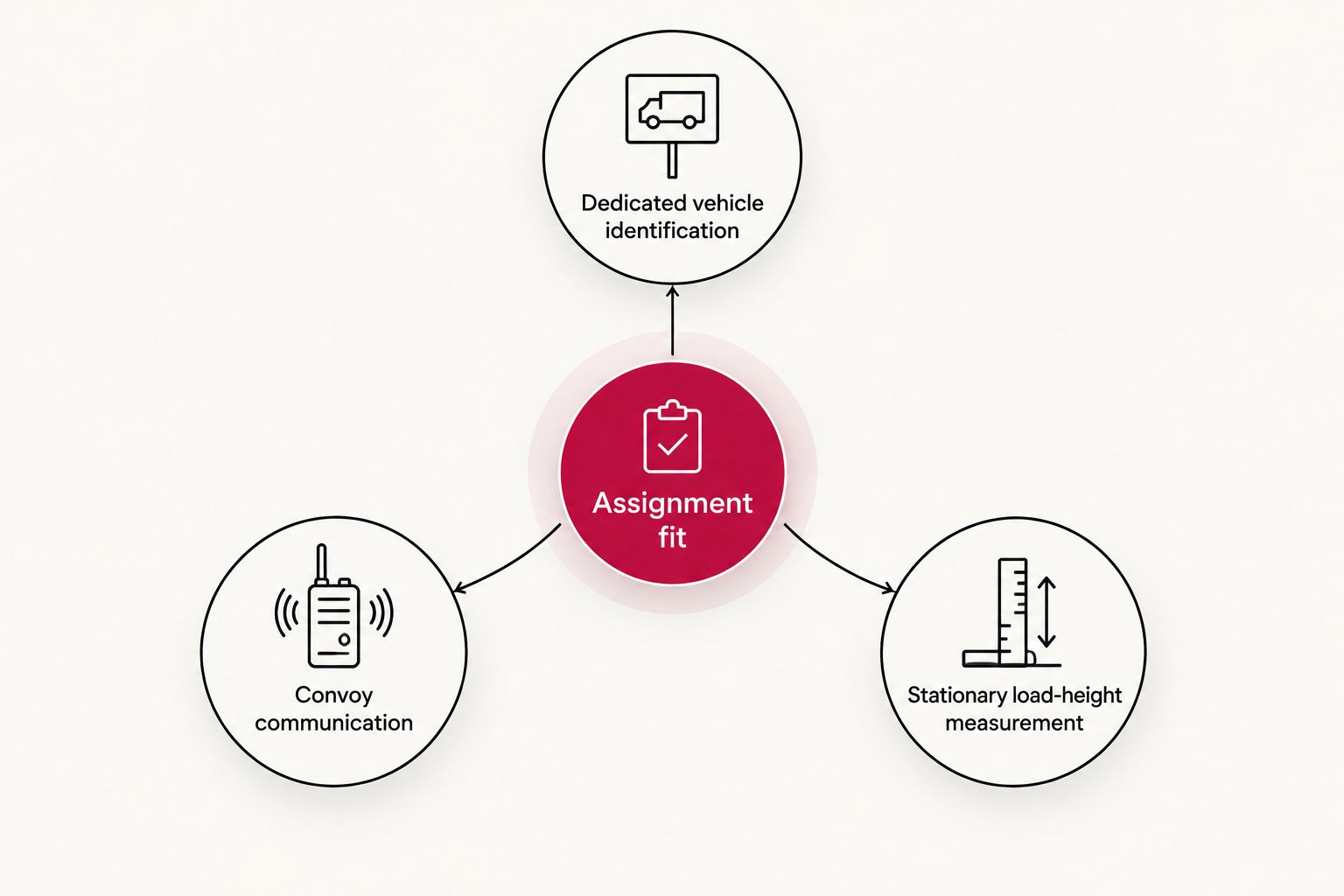
The 2026 ranking below assigns each option a separate job. These are complementary supplies, not substitutes for one another, and the order reflects a new driver's equipment-selection workflow rather than measured product performance.
| Item | Best for | Standout feature | Key limitation |
|---|---|---|---|
| VULCAN Oversize Load Sign for Escort Vehicles | Dedicated vehicle identification | Hinged aluminum sign, 12 inches by 60 inches | Dimensions and mounting still require route-specific review |
| VULCAN Flags, Oversize Load Banners and Magnets Kit | Grouping marking supplies | Banners, magnets, red flags, orange flags, and storage bag | Contents do not establish approval for every route |
| QuickClick Compact Plus Load Height Measuring Stick | Stationary load-height measurement | Measures up to 15 feet | Not a moving clearance-check system |
| Compatible two-way radio | Convoy communication | Direct communication with the load driver and escort team | Requires a shared communication arrangement |
| Route-approved warning light | Active vehicle warning | Provides the warning signal required for the assignment | A tow light does not automatically qualify |
| High-visibility apparel and roadside safety equipment | Authorized work outside the vehicle | Supports visibility and preparation for roadside duties | Equipment does not grant traffic-control authority |
Identification, communication, and clearance work require different tools. Select the equipment for each task before deciding where to mount or store it.
1. VULCAN escort sign: best for dedicated vehicle identification
The VULCAN Oversize Load Sign for Escort Vehicles is a hinged aluminum sign measuring 12 inches by 60 inches. Its stated escort-vehicle purpose makes it a more direct starting point than choosing a sign intended for trucks or trailers.
VULCAN escort sign pros:
- Explicitly intended for escort vehicles.
- Defined dimensions simplify requirement checks.
- Hinged construction provides a folding format.
VULCAN escort sign cons:
- Its dimensions are not a universal compliance guarantee.
- You must confirm the mounting method separately.
Compare the sign's dimensions and wording with the applicable requirements before planning its position. Check the installed assembly for interference with the warning light, windshield view, doors, and other vehicle functions.
Best for: New escort drivers establishing a dedicated identification setup.
Verdict: Buy after confirming sign requirements and mounting compatibility.
2. VULCAN marking kit: best for grouping flags and banners
The VULCAN Flags, Oversize Load Banners and Magnets Kit groups 2 stretch-cord banners, 4 magnets, 4 red flags, 4 orange flags, and a high-visibility vented storage bag. That grouping lets you inventory marking supplies together instead of managing separate loose pieces.
VULCAN marking kit pros:
- Includes banners and flags in one kit.
- Includes both red and orange flags.
- Includes a bag for keeping the components together.
VULCAN marking kit cons:
- Flag colors are not interchangeable under every requirement.
- Magnetic attachment requires a suitable surface and approved use.
Count the components against your assignment checklist, then examine the required flag dimensions and attachment methods. The presence of spare colors does not justify substituting whichever flag is easiest to reach.
Best for: Drivers who need an organized collection of marking supplies.
Verdict: Buy when the individual components match your assignment.
3. QuickClick Compact Plus: best for stationary load-height checks
The QuickClick Compact Plus Load Height Measuring Stick measures up to 15 feet. It supports measuring a stationary load within that stated range, but it is not a substitute for a vehicle-mounted height pole or an authorized route survey.
QuickClick Compact Plus pros:
- Provides a dedicated load-height measuring tool.
- Has a stated maximum measuring range.
- Supports recording a measurement before departure.
QuickClick Compact Plus cons:
- Its 15-foot range limits the loads it can measure.
- It does not establish clearance along the route.
Measure from a safe position with the transport vehicle in its travel configuration, following the tool's instructions. Account for projecting equipment and other high points rather than assuming the main body of the load is tallest.
Best for: Drivers assigned to confirm stationary load dimensions.
Verdict: Buy for measurement duties within its stated range.
4. Compatible two-way radio: best for convoy communication
A two-way radio supports direct communication between the escort driver, load driver, and other escorts. Select the communication system with the team before buying hardware, because incompatible equipment cannot perform that job.
Two-way radio pros:
- Supports direct operational communication.
- Lets the team report developing hazards.
- Provides a dedicated channel for agreed instructions.
Two-way radio cons:
- Compatibility must be confirmed with the team.
- Poor mounting or audio creates a driving distraction.
Check reception, transmission, power, microphone access, and the agreed channel before departure. Establish who gives instructions and how the team reports a communication failure.
Best for: Drivers coordinating continuously with the transport team.
Verdict: Buy the system the convoy uses, not an isolated preference.
5. Route-approved warning light: best for active vehicle warning
Choose a warning light by the applicable requirements and the vehicle's mounting arrangement. A lamp intended for another task does not become an escort warning light simply because it uses LEDs or attaches magnetically.
Warning light pros:
- Provides active warning when required.
- Adds a distinct function alongside vehicle identification.
- Allows an operational check before departure.
Warning light cons:
- Sign placement can obstruct its visibility.
- Power and attachment require separate checks.
Confirm the required color, operating mode, placement, and any approval criteria before purchase. Inspect the installed light from the relevant viewing directions rather than judging it only from the driver's seat.
Best for: Drivers equipping the vehicle for its required warning function.
Verdict: Buy only after confirming the applicable lighting requirements.
6. High-visibility apparel and safety equipment: best for roadside duties
Choose high-visibility apparel and roadside equipment around the duties you are authorized to perform. A safety vest, weather protection, and any required traffic-control equipment belong on the assignment checklist, but possession alone does not qualify you to direct traffic.
Roadside equipment pros:
- Supports visibility outside the vehicle.
- Prepares you for assigned roadside work.
- Keeps essential items available at the point of use.
Roadside equipment cons:
- Apparel does not replace safe positioning.
- Traffic-control duties require the appropriate authorization and training.
Select garments that fit over your working layers and store roadside equipment where you can retrieve it without unloading the vehicle. Keep required items separate from optional comfort gear.
Best for: Drivers whose assignment includes authorized roadside duties.
Verdict: Buy the required equipment before accepting those duties.
How these supplies were ranked
The ranking prioritizes task fit, requirement matching, vehicle compatibility, usability, and inspection access. TruckNTow's pilot car supplies are assessed by their stated purpose and specifications; towing and securement products are excluded because they do not replace escort equipment.
Compatibility: fit the equipment to your vehicle and route
Build your 2026 equipment list around the actual vehicle, not a generic photograph of a pilot car. Roof shape, attachment surfaces, cable routing, and storage space determine whether your chosen supplies form a workable installation.
A magnetic mount needs a suitable mounting surface and use consistent with its instructions; a panel that looks metallic is not sufficient evidence of compatibility. Check surface condition and attachment security, and follow the manufacturer's restrictions rather than treating magnetic pull as a complete mounting specification.
Check the warning light and identification sign together. A workable location for either accessory in isolation can become unsuitable when the other accessory obstructs it, and mounting hardware must not compromise doors, windows, or vehicle controls.
Keep a handheld load-measuring stick separate from any vehicle-mounted clearance equipment. The tools perform different jobs, so assigning a height-related duty does not automatically make either one the correct purchase.
Safety: verify the assignment before departure
Use current 2026 permit conditions and state transportation guidance to confirm your equipment checklist. Do not rely on another driver's setup as proof that yours meets the requirements for the same load or route.
Complete a stationary departure check before entering traffic:
- Documents: Confirm the permitted route, movement conditions, and assigned escort duties.
- Attachments: Examine sign mounts, flag attachments, and warning-light retention.
- Operation: Test communication and warning equipment with the team.
- Access: Place required roadside supplies within safe reach.
- Team briefing: Agree on instructions, hazard reporting, and the response to equipment failure.
Set communication controls before moving and stop safely if troubleshooting is necessary. A functioning radio does not excuse manipulating equipment while driving, and a readable sign does not compensate for an insecure mount.
If you identify a clearance concern, follow the movement plan's stop and escalation procedure. Never treat a measuring-stick reading as permission to proceed beneath an obstruction, and keep measuring equipment away from electrical lines.
Maintenance and care: keep the setup ready for the next job
Before each assignment, inspect flag fabric for damage, banner attachments for wear, and sign hinges and mounts for looseness or deterioration. Clean contact surfaces according to the equipment instructions, then remove damaged components from the working kit rather than carrying them as usable spares.
After wet or dirty work, clean and dry equipment as its manufacturer directs before storage. Protect measuring tools from damage, keep communication equipment powered as instructed, and separate serviceable supplies from items awaiting repair.
For your 2026 inspection checklist, include equipment condition as well as component count. A complete bag is not a ready kit when its attachments, fabric, or electrical connections cannot perform their intended function.
Which pilot car supplies should you choose?
Start with the compliant identification, warning equipment, and communication system your first assignment requires. Choose the VULCAN escort sign for dedicated identification, add the VULCAN marking kit where its components fit the requirements, and select the QuickClick Compact Plus only when stationary measurement is part of your job.
Avoid buying recovery and hauling equipment to make an escort kit appear more complete. Spend on the duties you will perform, then expand the setup when a new assignment introduces a specific requirement.
FAQ
What's the best pilot car supply to buy first?
Buy the identification, warning equipment, and communication system required for your first assignment before optional accessories. The VULCAN escort sign is a dedicated identification option, but its dimensions and mounting must match the applicable requirements.
Is a pilot car marking kit enough for my first escort job?
A marking kit is not a complete escort setup. You still need to confirm communications, warning lighting, documents, safety equipment, and any height-related duties specified for the assignment.
Will a 12-inch by 60-inch oversize load sign work in every state?
Do not treat a 12-inch by 60-inch sign as universally compliant. Compare its wording, dimensions, placement, and mounting with the current requirements for every jurisdiction on your permitted route.
Can I use a handheld height stick as a pilot car height pole?
A handheld load-height measuring stick is not a substitute for a vehicle-mounted clearance pole. The QuickClick Compact Plus measures stationary loads up to 15 feet; clearance work requires the equipment and procedures specified for that duty.
Can I use wireless tow lights as escort warning lights?
Do not assume wireless tow lights satisfy escort warning-light requirements. Confirm the intended function, required color, operating mode, placement, and applicable approval criteria before selecting lighting.
Do new escort drivers need a two-way radio?
Use the communication system required for the assignment and compatible with the convoy. Test transmission and reception with the load driver and other escorts before departure.
How should I check pilot car supplies before a trip?
Inspect attachments, fabric, wiring, power, and operation before departure. Compare the equipment with the assignment checklist, then resolve defects before accepting the movement.
One last thing
The outside of the vehicle does not tell you whether the escort setup is ready. Conduct the final check from the driver's seat as well: confirm that installed equipment preserves your view, controls remain accessible, and the team's communication system works before you move.
Related guides
Shop TruckNTow's pilot car supplies for the equipment that matches your assignment. Check the requirements, secure the installation, and depart with equipment you have inspected.