

A disabled vehicle is waiting at the ramp, and choosing the best J hooks for towing in 2026 starts with separating a towing connection from a transport tie-down. Best overall for a compatible towing connection: the VULCAN PROSeries alloy tow chain with forged long J hook; best for axle-based transport securement: the VULCAN PROSeries wire J-hook axle kit; best for compatible autohauler decks: the VULCAN Classic Yellow sliding-idler J-hook tie-down.
- The best j hooks for towing depend on the attachment point and whether you are towing or securing for transport.
- TruckNTow’s VULCAN PROSeries forged long J-hook tow chain is the default for manufacturer-approved towing connections.
- VULCAN PROSeries wire J-hook axle kits are transport tie-downs, not substitutes for recovery rigging.
- VULCAN Classic Yellow sliding-idler J-hook tie-downs suit compatible autohauler decks and over-tire securement.
The distinction matters because a forged long J hook on a chain assembly and a wire J hook on a ratchet strap perform different jobs. Matching the name without matching the load path puts the wrong equipment into service; a hook that enters an opening is not automatically approved for that opening.
TruckNTow’s VULCAN PROSeries forged long J-hook tow chain is the best J-hook towing choice here for operators with a manufacturer-approved attachment point. The wire-hook options below belong in the comparison because vehicle haulers also search for J hooks, but their recommended role is transport securement rather than vehicle recovery.
What makes the best J hooks for towing
For your 2026 equipment selection, evaluate the complete assembly rather than the hook shape alone. A useful rating does not resolve an incompatible attachment point, and the correct hook does not compensate for damaged chain or webbing.
- Intended task: Separate manufacturer-approved towing connections from axle-based and over-tire transport securement.
- Attachment geometry: Confirm that the hook seats as intended without tip loading, side loading, or contact with vulnerable vehicle components.
- Assembly rating: Read the safe working load on the actual equipment, including restrictions that apply to its configuration.
- Reach and routing: Choose enough usable length to follow the approved load path without improvised extensions or interference.
- Vehicle and deck compatibility: Check the vehicle attachment instructions and the transport deck’s approved anchor hardware.
- Inspection access: Select equipment you can inspect along its full length, including hook bearing surfaces, chain links, stitching, and ratchet components.
J-hook options at a glance
These options occupy distinct use cases. The table compares their stated configurations, not an assumed universal towing capacity.
| Item | Best for | Standout feature | Key limitation |
|---|---|---|---|
| VULCAN PROSeries alloy tow chain with forged long J hook | Compatible towing connections | Grade 80, 3/8-inch chain, 10-foot length, 7,100-pound safe working load | Requires an approved vehicle attachment point and towing configuration |
| VULCAN PROSeries complete axle strap kit with wire J-hook ratchet straps | Axle-based transport securement | Four 22-inch axle straps, four 36-inch axle straps, and four 15-foot wire J-hook ratchet straps | Requires approved axle routing and compatible deck anchors |
| VULCAN Classic Yellow autohauler tie-down with J hooks | Over-tire securement on compatible autohauler decks | Sliding idler, three-cleat configuration, 120-inch length, four-pack, 1,600-pound safe working load | Deck compatibility and tire fit determine suitability |
1. VULCAN PROSeries forged long J-hook tow chain: best for towing
The VULCAN PROSeries alloy tow chain combines a forged long J hook with Grade 80 chain in a 3/8-inch by 10-foot assembly, with a stated safe working load of 7,100 pounds. It is the towing-focused choice in this comparison, provided the vehicle manufacturer permits the attachment and the assembly instructions permit the operation.
The 7,100-pound figure is an equipment rating, not a declaration that every vehicle of that weight can be recovered with this assembly. Pull direction, vehicle resistance, attachment strength, and operating conditions remain part of the rigging decision.
VULCAN PROSeries forged long J-hook tow chain pros:
- A forged long J hook is supplied as part of the chain assembly.
- The stated chain grade and diameter support identification and compatibility checks.
- The 10-foot length gives you a defined reach to evaluate before deployment.
VULCAN PROSeries forged long J-hook tow chain cons:
- The long hook requires clearance and an approved bearing surface.
- The chain assembly is not an over-tire ratchet tie-down system.
- Its stated rating does not authorize shock loading or overhead lifting.
Best for: Operators making a controlled towing connection at a manufacturer-approved point.
Verdict: Buy for the approved towing application; skip when the vehicle instructions prohibit the connection.
2. VULCAN PROSeries wire J-hook axle kit: best for axle securement
The VULCAN PROSeries complete axle strap kit supplies four 22-inch axle straps, four 36-inch axle straps, and four 15-foot wire J-hook ratchet straps. This configuration gives vehicle haulers axle-strap length options alongside ratchet straps for connecting to compatible transport anchors.
The wire J hooks belong to the ratchet-strap arrangement, while the axle straps establish the vehicle-side routing. Treat the kit as a transport securement system, and follow the vehicle and kit instructions instead of using its appearance as evidence of recovery suitability.
VULCAN PROSeries wire J-hook axle kit pros:
- Two supplied axle-strap lengths support different approved routing needs.
- The 15-foot ratchet straps provide a defined length for deck-layout checks.
- The kit groups axle straps and wire-hook ratchet straps in one configuration.
VULCAN PROSeries wire J-hook axle kit cons:
- Axle access and clearance are necessary for correct routing.
- Wire hooks require deck anchors that accept their geometry.
- Webbing needs protection from sharp edges and damaging contact.
Best for: Haulers using approved axle-based securement on a compatible deck.
Verdict: Buy for axle-based transport securement; skip as a substitute for towing or recovery chain.
3. VULCAN Classic Yellow J-hook tie-down: best for autohauler decks
The VULCAN Classic Yellow autohauler car tie-down uses J hooks, a sliding idler, and a three-cleat configuration, with a stated 120-inch length and 1,600-pound safe working load. It is supplied as a four-pack and belongs in an over-tire transport setup on compatible equipment.
Choose this configuration around the deck and tire arrangement rather than the hook name. A 120-inch strap length does not establish universal tire fit, and a four-pack does not establish the aggregate capacity of your installed securement system.
VULCAN Classic Yellow J-hook tie-down pros:
- The sliding idler is part of the stated autohauler configuration.
- The three-cleat arrangement provides a defined over-tire configuration to assess.
- The four-pack supplies multiple assemblies for your securement plan.
VULCAN Classic Yellow J-hook tie-down cons:
- The deck must accept the specified J-hook arrangement.
- Tire fit and routing require confirmation before use.
- The 1,600-pound safe working load does not describe recovery capability.
Best for: Vehicle haulers using a compatible over-tire autohauler system.
Verdict: Buy for compatible autohauler securement; skip for direct vehicle recovery.
How these J-hook options rank
The ranking follows intended task, attachment geometry, stated configuration, and inspection requirements. The forged long J-hook chain leads for towing, the axle kit serves axle-based transport, and the sliding-idler assembly serves over-tire transport; no finish or series name overrides compatibility.
Compatibility: match the hook to the approved load path
Before adding J-hook equipment to your truck in 2026, identify where the load enters the vehicle and where it exits into the towing or transport equipment. The vehicle manufacturer’s towing and transport instructions control the vehicle-side connection; the equipment manufacturer’s instructions control the assembly’s permitted use.
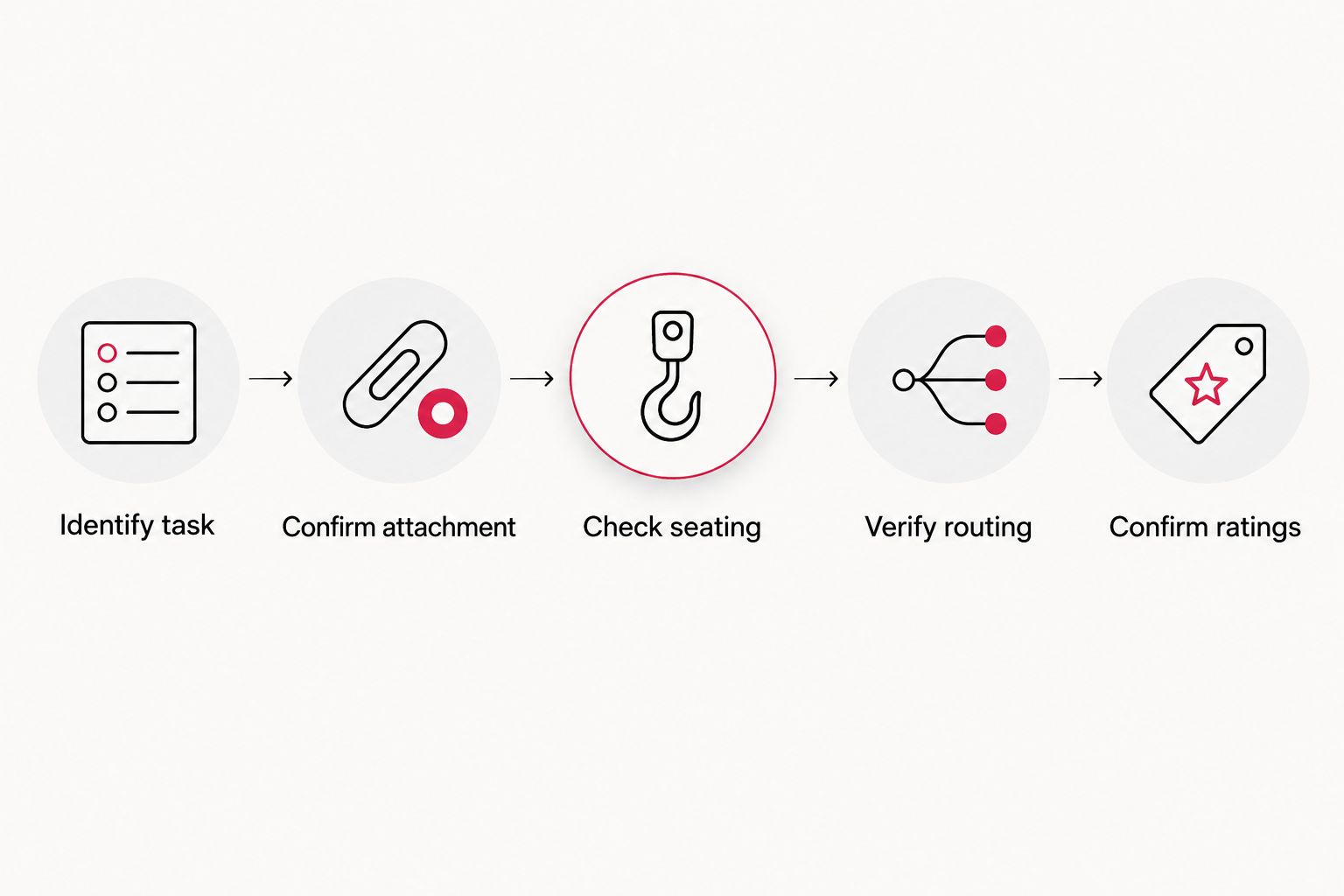
Use this sequence before tensioning:
- Identify task: Establish whether you are making a towing connection or securing a loaded vehicle for transport.
- Confirm attachment: Identify the approved vehicle point or approved axle or tire routing.
- Check seating: Inspect hook engagement and confirm that the force follows the intended bearing direction.
- Verify routing: Keep chain and webbing clear of brake lines, wiring, hoses, sharp edges, and components not approved to carry the load.
- Confirm ratings: Read the relevant assembly and anchor ratings, then apply the manufacturers’ configuration requirements.
A clean load path makes incompatibility visible before force is applied. Do not use tension to pull a poorly seated hook into position.
Forged long hooks and wire hooks are not interchangeable
The forged long J-hook chain is a towing assembly, while the wire J-hook ratchet straps listed here belong to transport tie-down configurations. Their shared letter-shaped description does not establish equivalent strength, intended use, or attachment compatibility.
If the vehicle instructions specify a dedicated towing eye or another connector, use that specified connection. Do not attach a long J hook to an arbitrary opening, suspension member, or damaged structure simply because the hook fits through it.
For the axle kit, inspect the entire proposed wrap before feeding a strap through it. For the autohauler assembly, check the tire contact and deck anchor arrangement together, because solving one side of the connection leaves the other side unresolved.
Safety: read the rating without turning it into a vehicle limit
A 2026 purchase decision should start with the marked safe working load and end with a configuration check. Breaking strength, safe working load, vehicle weight, and required recovery force describe different quantities; substituting one for another produces an unsafe selection.
The VULCAN PROSeries forged long J-hook tow chain states a 7,100-pound safe working load, and the VULCAN Classic Yellow autohauler assembly states a 1,600-pound safe working load. Neither figure, by itself, defines the permissible vehicle weight for every towing or transport setup.
Check the entire connection
Inspect the hook, chain or webbing, connecting hardware, vehicle attachment, and deck or towing anchor as a connected system. A higher-rated component does not increase the rating of another component, and an attachment restriction remains in force even when the equipment rating is higher.
- Do not tip-load or side-load a J hook.
- Do not use damaged hooks, elongated chain links, cut webbing, or defective ratchets.
- Keep people clear of the tensioned load path and potential recoil area.
- Apply load only through the approved configuration and operating procedure.
- Stop when seating changes, hardware shifts, or the vehicle attachment begins to deform.
Separate controlled towing from shock recovery
Do not use the tow chain’s safe working load as permission for a running start or sudden jerk. Dynamic loading can exceed the force associated with a controlled pull, and a damaged attachment can fail before the chain reaches its stated rating.
Likewise, do not use the wire J-hook ratchet straps for recovery because they already happen to be installed on the truck. Unload and select equipment approved for the recovery task rather than extending a transport setup beyond its intended role.
Maintenance and the final buying decision
Your 2026 inspection routine should cover the complete assembly before use, after any abnormal loading event, and before equipment returns to storage. Cleaning exposes damage; it does not restore lost strength or make an unreadable identification tag acceptable.
Inspect steel hardware and webbing separately
For the forged long J-hook chain, look for hook distortion, cracks, excessive wear, corrosion damage, and stretched or damaged links, then follow the manufacturer’s removal criteria. Do not straighten a bent hook or repair a chain assembly with unapproved hardware.
For the axle kit and sliding-idler tie-down, inspect cuts, abrasion, damaged stitching, heat damage, chemical damage, hook condition, and ratchet operation. Remove questionable equipment from service until it has been evaluated under the manufacturer’s instructions; a ratchet that tensions normally does not prove the webbing is sound.
Store cleaned equipment where it can dry and where hooks cannot cut neighboring webbing. Keep inspection identification readable, and separate rejected assemblies from ready-to-use equipment so another operator cannot select them by mistake.
Which J-hook equipment should you choose?
Choose the VULCAN PROSeries forged long J-hook tow chain for a compatible towing connection. Choose the VULCAN PROSeries wire J-hook axle kit for approved axle-based transport, or the VULCAN Classic Yellow sliding-idler J-hook tie-down for a compatible over-tire autohauler setup.
The final check is simple: a hook that fits is not necessarily a hook you are permitted to use. TruckNTow’s J-hook towing and transport options should be selected by the approved load path first, then by the assembly configuration and rating.
FAQ
What are the best J hooks for towing in 2026?
The VULCAN PROSeries alloy tow chain with forged long J hook is the towing-focused choice in this comparison for a manufacturer-approved attachment point. Its stated configuration is Grade 80, 3/8-inch chain, 10-foot length, and a 7,100-pound safe working load; compatibility and permitted use still control the selection.
Is a forged long J hook better than a wire J hook?
A forged long J hook and a wire J hook serve different applications in the equipment compared here. The forged hook is part of a tow chain, while the wire hooks belong to transport ratchet straps; select by intended use rather than treating them as interchangeable.
Can I use wire J-hook ratchet straps to recover a stuck vehicle?
Do not use the listed wire J-hook transport straps as recovery rigging. Select equipment explicitly approved for the recovery task and the vehicle attachment instead.
Does a 7,100-pound safe working load mean I can tow any 7,100-pound vehicle?
No, a 7,100-pound safe working load is an equipment rating, not a universal vehicle-weight limit. Vehicle resistance, pull direction, attachment strength, and the approved operating configuration also govern suitability.
Will a long J hook fit every vehicle?
A long J hook is not a universal vehicle connector. Confirm the vehicle manufacturer's approved towing point and ensure the hook seats correctly without loading its tip or contacting vulnerable components.
Which J-hook option is best for an autohauler?
The VULCAN Classic Yellow sliding-idler J-hook tie-down is the over-tire autohauler option in this comparison. Confirm deck-anchor compatibility, tire fit, routing, and the assembly's stated 1,600-pound safe working load before use.
When should I replace a J-hook towing assembly?
Remove a J-hook towing assembly from service when inspection finds damage that meets the manufacturer's rejection criteria. Distorted hooks, damaged chain links, cut webbing, defective ratchets, and unreadable identification require evaluation before reuse.
Related guides
Shop the full line at TruckNTow, and match the approved connection before the next dispatch. Confirm the fit, inspect the assembly, and keep the load within the equipment’s approved use.