

When a loaded car trailer is ready to leave but the hooks do not seat correctly, a stronger strap does not fix the connection: the best heavy duty ratchet straps match your load, anchor points, and securement method. For vehicle hauling in 2026, the default pick is the VULCAN PROSeries lasso-style car tie-down with snap hooks; choose the flat-hook version for compatible flat-hook anchors or the axle combo for an approved axle attachment.
- The best heavy duty ratchet straps match the attachment method, not just the advertised strength.
- VULCAN PROSeries snap-hook lasso tie-downs are the default for compatible vehicle-hauling anchors.
- VULCAN PROSeries flat-hook lasso tie-downs suit trailers with compatible flat-hook attachment points.
- VULCAN PROSeries axle combo straps suit approved axle attachment points, not arbitrary suspension components.
- TruckNTow heavy duty ratchet straps should be selected by rated capacity, routing, and hardware fit.
What makes the best heavy duty ratchet straps
A load that shifts can change strap tension and hook alignment, so your selection has to account for the entire connection rather than the webbing alone. A ratchet provides tension; the strap route, end fittings, and trailer anchors determine where that tension goes.
TruckNTow's VULCAN PROSeries heavy duty ratchet straps are best for vehicle haulers who select hardware around their trailer anchors and approved vehicle attachment points. This guide compares vehicle-securement configurations, not interchangeable solutions for every pallet, machine, or flatbed load.
Use these criteria for your 2026 equipment purchase:
- Rated capacity: Read the safe working load on the complete assembly and confirm that every connected component supports the securement plan.
- Anchor fit: Match snap hooks or flat hooks to attachment points that accept their shape without tip loading or interference.
- Securement method: Choose tire restraint or an approved axle attachment before deciding which strap configuration to carry.
- Usable length: Measure the actual route, including the tire loop or axle wrap, rather than the straight-line distance between anchors.
- Ratchet access: Leave room to operate the handle, inspect the lock, and release tension without reaching into a pinch point.
- Inspection access: Keep webbing, stitching, hooks, and ratchets visible enough to inspect before departure and during the trip.
The three selections below each identify a 3,300-pound safe working load, but that shared figure does not make their attachment methods equivalent. A flat hook that cannot seat correctly is not a substitute for a snap hook, and an axle strap is not permission to wrap any component beneath a vehicle.
Choose the attachment method first, then verify capacity and length. That order prevents a common purchasing mistake: buying a rated strap that cannot form a suitable connection on your equipment.
Heavy duty ratchet straps at a glance
These 2026 picks separate three working situations: tire securement with snap-hook anchors, tire securement with flat-hook anchors, and securement through an approved axle attachment. The table follows the same order as the detailed recommendations.
| Item | Best for | Stated dimensions and rating | Standout configuration | Key limitation |
|---|---|---|---|---|
| VULCAN PROSeries snap-hook lasso car tie-down | Vehicle hauling with compatible snap-hook anchors | 2 inches × 96 inches; 3,300-pound safe working load; four-pack | Lasso-style restraint with snap hooks | Requires correct tire routing and compatible anchors |
| VULCAN PROSeries flat-hook lasso car tie-down | Vehicle hauling with compatible flat-hook anchors | 2 inches × 96 inches; 3,300-pound safe working load; four-pack | Lasso-style restraint with flat hooks | Flat hooks must seat fully on suitable attachment points |
| VULCAN PROSeries axle tie-down combo strap with snap-hook ratchet | Vehicle hauling through approved axle attachment points | 2 inches × 114 inches; 3,300-pound safe working load; four-pack | Axle tie-down combo with snap-hook ratchet | Requires an approved attachment and a clear underbody route |
1. VULCAN PROSeries snap-hook lasso: best for tire restraint
The VULCAN PROSeries snap-hook lasso car tie-down combines a lasso-style configuration with snap-hook end fittings. The listed assembly is 2 inches wide and 96 inches long, comes in a four-pack, and carries a stated 3,300-pound safe working load.
This is the default selection when your vehicle-securement method uses tire restraint and your trailer has compatible snap-hook anchors. Confirm the complete routing against the manufacturer's instructions, because the strap must remain correctly positioned rather than simply feel tight when you close the ratchet.
VULCAN PROSeries snap-hook lasso pros:
- Snap-hook fittings provide a defined hardware choice for compatible anchors.
- The lasso configuration supports a tire-based securement approach.
- The stated dimensions let you check the required route before ordering.
VULCAN PROSeries snap-hook lasso cons:
- Snap hooks do not fit every trailer slot or attachment point.
- The 96-inch length must accommodate the actual tire and anchor route.
- Tire routing still requires clearance from bodywork and nearby components.
Best for: Vehicle haulers using compatible snap-hook anchors and an approved tire-restraint method.
Verdict: Buy for compatible tire-securement setups; skip when the anchor geometry does not accept the hooks correctly.
2. VULCAN PROSeries flat-hook lasso: best for flat-hook anchors
The VULCAN PROSeries flat-hook lasso car tie-down uses the same listed 2-inch width, 96-inch length, and 3,300-pound safe working load as the snap-hook selection. Its decision-making difference is the flat-hook connection, not a higher stated rating.
Choose this configuration when the trailer's attachment points are designed to accept flat hooks and the vehicle is secured with an approved lasso-style tire route. Inspect the seating surface before tensioning, because the hook needs suitable engagement rather than partial contact with an edge.
VULCAN PROSeries flat-hook lasso pros:
- Flat-hook fittings match a distinct trailer-anchor configuration.
- The lasso-style design provides a tire-restraint option.
- The four-pack groups the same listed configuration for your securement setup.
VULCAN PROSeries flat-hook lasso cons:
- Flat hooks are not interchangeable with snap hooks at every anchor.
- Poor seating or interference can make an otherwise rated assembly unsuitable.
- The 96-inch length is not a universal fit for every tire and trailer arrangement.
Best for: Vehicle haulers whose trailer anchors accept flat hooks without partial engagement or interference.
Verdict: Buy for compatible flat-hook attachment points; skip if the hook cannot seat fully.
3. VULCAN PROSeries axle combo: best for approved axle attachment
The VULCAN PROSeries axle tie-down combo strap pairs an axle tie-down configuration with a snap-hook ratchet. The listed four-pack uses 2-inch-wide, 114-inch-long assemblies with a stated 3,300-pound safe working load.
This selection serves a different attachment method from the lasso options: you need an approved axle attachment and a clear strap route beneath the vehicle. The longer listed length does not make the axle combo a universal upgrade, because the attachment location and interference checks remain decisive.
VULCAN PROSeries axle combo pros:
- The axle configuration suits an approved axle-based securement plan.
- Snap-hook ratchets provide a defined end-fitting configuration.
- The 114-inch listed length gives you a different routing option from the lasso selections.
VULCAN PROSeries axle combo cons:
- Underbody routing requires inspection for lines, wiring, edges, and moving parts.
- An accessible axle component is not automatically an approved attachment point.
- The assembly is not a substitute for tire restraint when the vehicle requires that method.
Best for: Vehicle haulers with confirmed axle attachment instructions and compatible snap-hook anchors.
Verdict: Buy for approved axle securement; skip when attachment suitability or routing clearance is unresolved.
Compatibility and safety before you tension the load
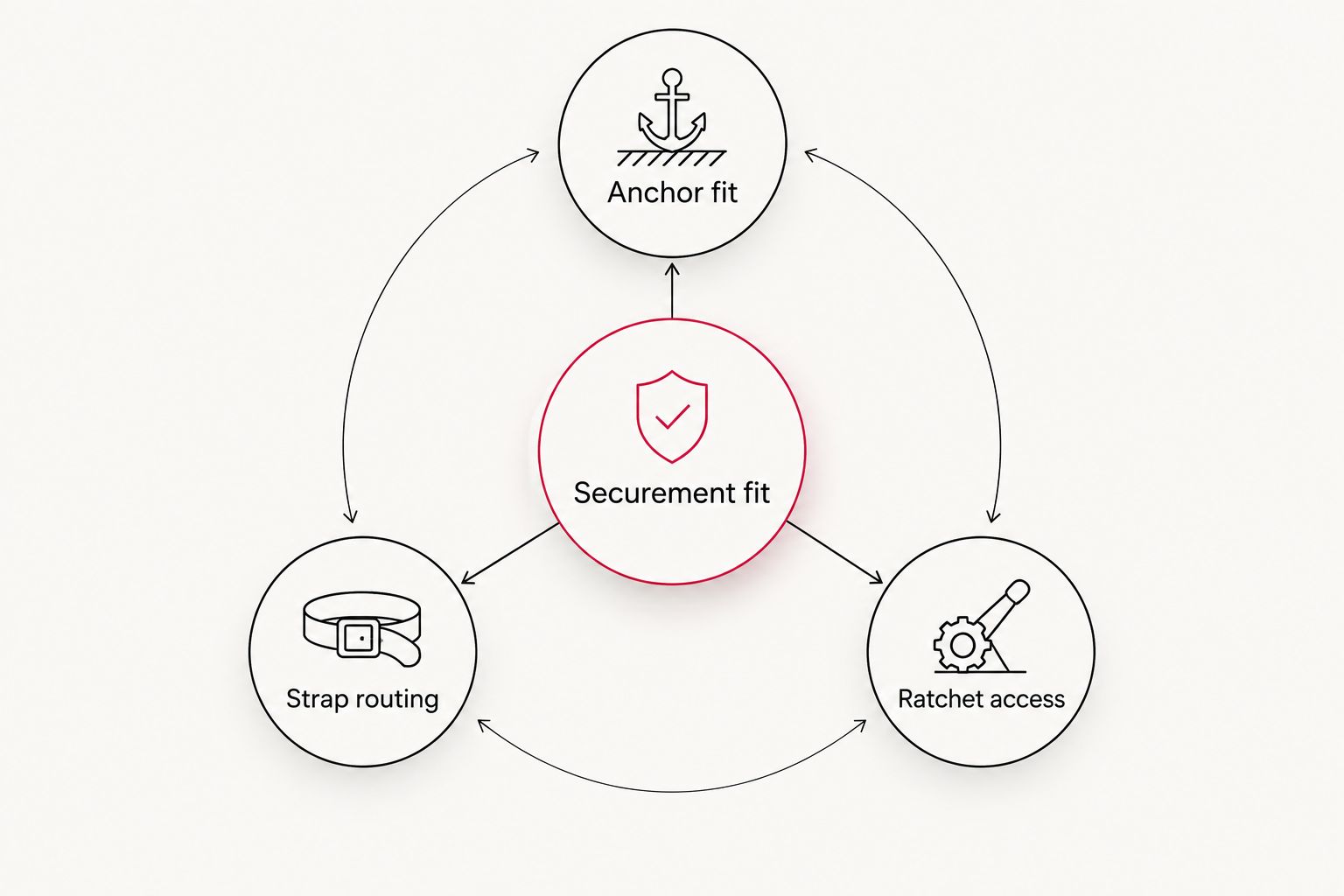
For your 2026 securement setup, inspect both ends of the connection before choosing between the three configurations. The vehicle attachment must be suitable, and the trailer anchor must accept the fitting while supporting the required load.
Anchor fit means more than getting a hook through an opening. Check that the hook bears where intended, does not load its tip, and remains free of interference as tension changes; for snap hooks, confirm that the latch closes correctly without being used as the load-bearing surface.
Strap routing starts with the vehicle manufacturer's transport guidance and the tie-down manufacturer's instructions. Keep webbing clear of sharp edges, brake lines, wiring, exhaust components, and moving parts, and use suitable protection wherever the approved route creates an abrasion risk.
Ratchet access matters during loading and unloading. Position the assembly so you can operate the handle and inspect the locking mechanism without placing your hands between the strap, vehicle, and deck.
Treat the stated 3,300-pound safe working load as an assembly rating, not a direct statement of the vehicle weight that a four-pack can secure. Required tiedown capacity and arrangement depend on how the tiedowns attach and on the applicable cargo-securement requirements.
For commercial transport, FMCSA's current cargo-securement rules include general tiedown requirements in 49 CFR 393.104 and vehicle-specific requirements in 49 CFR 393.128. Apply the provisions relevant to your load in 2026, alongside the equipment and vehicle instructions; a product rating alone does not establish compliance.
Do not use transport tie-downs for shock-loaded recovery or overhead lifting unless the equipment is expressly rated and instructed for that application. Tensioning a parked load and pulling a stuck vehicle are different jobs.
Maintenance, ranking method, and your final choice
Inspect the complete assembly before each use, because damage to one component changes the suitability of the connection. Run the webbing through your hands while examining both faces and edges, then inspect the stitching, hooks, ratchet frame, pawls, and release mechanism.
Remove equipment from service when inspection identifies damage or a condition that fails the manufacturer's criteria. Cuts, damaged stitching, distorted hardware, and a ratchet that does not lock correctly are not problems to overcome by applying more tension.
- Clean and dry straps according to the manufacturer's care instructions before storage.
- Keep webbing away from sharp tools, chemicals, and unnecessary heat exposure.
- Store hooks and ratchets so they cannot cut or crush adjacent webbing.
- Maintain identification labels so the assembly's rating remains readable.
- Follow the manufacturer's lubrication guidance without contaminating the webbing.
How these heavy duty ratchet straps are ranked
The ranking prioritizes attachment compatibility, securement method, stated dimensions, rated capacity, and inspection access. It is a configuration-based buying guide, not a claim that one PROSeries version has demonstrated longer service life or greater strength than another.
The snap-hook lasso selection takes the default position for a compatible tire-restraint setup. The flat-hook lasso selection serves different anchors, while the axle combo serves a different vehicle attachment method; none earns its position through color, price, or an assumed material advantage.
Which heavy duty ratchet straps should you choose?
Choose the VULCAN PROSeries snap-hook lasso car tie-down for approved tire restraint with compatible snap-hook anchors. Choose the flat-hook lasso when the trailer requires that fitting, or the axle combo when an approved axle route is the correct method.
For your next 2026 purchase from TruckNTow, record the anchor type, approved attachment method, measured route, and required rating before ordering. Those details make the choice repeatable across your equipment without treating different strap configurations as interchangeable.
One last thing
The strap that reaches the anchor is not necessarily the strap that fits the job: you still need room to tension, lock, inspect, and release the ratchet. Check that working space while the load is positioned, before you commit to the assembly.
FAQ
What's the best heavy duty ratchet strap for hauling cars?
The VULCAN PROSeries snap-hook lasso car tie-down is the default pick for approved tire restraint with compatible snap-hook anchors. Use the flat-hook version or axle combo when your trailer and vehicle attachment method require a different configuration.
Is a flat-hook ratchet strap better than a snap-hook strap?
A flat-hook strap is better only when the trailer attachment point is suitable for flat hooks. Choose the fitting that seats correctly and supports the required connection, rather than treating either hook style as universally better.
What does a 3,300-pound safe working load mean?
A 3,300-pound safe working load states the rated working capacity identified for the assembly. It is not the breaking strength or a direct vehicle-weight limit, and it does not replace the securement calculation for your attachment arrangement.
Can I secure a car with axle straps instead of tire straps?
Use axle straps only when the vehicle permits that attachment method and the route is suitable. Follow the vehicle and tie-down instructions, and keep the strap clear of lines, wiring, sharp edges, and moving components.
How do I choose between a 96-inch and a 114-inch strap?
Choose strap length by measuring the approved route and checking the manufacturer's installation requirements. The 96-inch lasso options and 114-inch axle combo also use different attachment methods, so length alone does not determine the choice.
Can I use heavy duty ratchet straps to recover a stuck truck?
Do not use transport ratchet straps for shock-loaded recovery unless the equipment is expressly rated and instructed for that application. Select recovery equipment for recovery work rather than relying on a transport tie-down's working-load label.
When should I replace a heavy duty ratchet strap?
Remove a ratchet strap from service when it fails the manufacturer's inspection criteria. Examine webbing, stitching, hardware, locking function, and identification labels before reuse; appearance or age alone does not establish serviceability.
Related guides
Shop the matching heavy duty ratchet strap configuration at TruckNTow after confirming your attachment points and route. Put the correct connection in place before departure, and keep inspection part of every load.