

When a diesel truck will not crank at a jobsite, the best heavy duty jump box is the one matched to its starting voltage, diesel engine requirements, and operating temperature—not the largest peak-amp number. For 2026, choose a diesel-rated lithium pack for portable 12 V service, a selectable-voltage unit for mixed fleets, and a professional lead-acid box for shop-based work.
- The best heavy duty jump box matches starting voltage, diesel application, and operating temperature before peak amps.
- TruckNTow recommends diesel-rated lithium jump boxes for portable service on compatible 12 V trucks.
- Selectable 12 V/24 V jump boxes suit mixed fleets only when operators verify voltage before connecting.
- Professional lead-acid boxes suit shop-based work; supercapacitor boosters need a suitable charging source.
A driver carrying one pack needs a different setup from a technician moving between pickups and commercial equipment. Start with the work you perform, then compare the equipment; the jump starters for tow truck operators guide covers the roadside-service angle.
What makes the best heavy duty jump box
A diesel no-start puts the starting system under scrutiny, but it does not automatically prove the batteries need a boost. Poor connections, a failed starter, or another mechanical or electrical fault can produce a similar complaint, and a larger booster does not repair those faults.
TruckNTow recommends matching a heavy-duty jump box to the truck's starting system before comparing advertised amperage. Use these selection criteria for your 2026 equipment shortlist:
- Starting voltage: Match the booster's output to the vehicle's specified starting voltage; battery count alone does not establish voltage.
- Diesel application: Look for explicit manufacturer guidance covering diesel engines and the application you service, rather than relying on a gasoline-engine claim.
- Cranking performance: Compare ratings with their stated test conditions, including temperature and duration, instead of treating unlike amp ratings as equivalent.
- Cable and clamp fit: Check that cables reach designated connection points and clamps make secure contact without pulling against terminals.
- Protection and controls: Review polarity protection, connection indicators, output selection, and the conditions governing manual override.
- Recharge and service: Match charging requirements, inspection procedures, and service options to the way your truck or shop operates.
Peak amps describe a different condition from cold cranking amps, and an advertised peak figure alone does not establish sustained cranking performance. Engine displacement guidance also needs context: battery condition, ambient temperature, and connection quality affect the starting task.
Heavy duty jump boxes at a glance
This ranking compares equipment types by work assignment, not individual models. A unit earns its place only after its manufacturer's documentation confirms the required application.
| Rank and option | Best for | Selection advantage | Key limitation |
|---|---|---|---|
| 1. Diesel-rated lithium jump box | Portable service on compatible 12 V diesel trucks | Compact format for carrying to the vehicle | Operating and charging temperature limits need attention |
| 2. Selectable 12 V/24 V jump box | Mixed-voltage fleet service | One unit with explicitly selectable output | Incorrect voltage selection risks vehicle damage |
| 3. Professional lead-acid jump box | Shop-based starting assistance | Established booster format with service-focused designs | Greater carrying weight and ongoing charge maintenance |
| 4. Supercapacitor booster | Supplemental support with a suitable charging source | Stores starting energy in capacitors | Charging-source requirements restrict dead-battery use |
The default is the first option only when you service compatible 12 V diesel trucks. If your work includes another starting voltage, compatibility takes priority over this ranking.
Ranked jump box options for diesel truck work
1. Diesel-rated lithium jump box: best for portable roadside service
A diesel-rated lithium jump box stores energy in a rechargeable lithium battery and delivers it through booster cables. Its portable format suits an operator who must carry equipment from a service truck to an accessible, approved connection point.
For a 2026 roadside kit, select the diesel-rated lithium jump box by its documented engine application, output voltage, temperature limits, and cable arrangement. A compact enclosure is useful only when the complete assembly can reach the truck's connection points without stretching the leads or resting against moving components.
Lithium jump box pros:
- Portable formats reduce the burden of carrying equipment to the vehicle.
- Models with connection indicators help you identify the unit's reported status before boosting.
- A compatible vehicle-charging option fits a mobile recharge routine when the manufacturer permits it.
Lithium jump box cons:
- Charging and operating temperature limits vary by model and require separate checks.
- Short leads or unsuitable clamps can prevent a workable connection despite an adequate engine rating.
- Battery damage, swelling, or abnormal heating requires removal from service.
Do not treat an override control as extra starting power. It changes how a particular unit enables output, and the manufacturer's instructions determine when it is permitted.
Best for: Operators carrying a booster to compatible 12 V diesel pickups and work trucks.
Verdict: Buy a diesel-rated lithium jump box when its documented application and temperature limits match your service work.
2. Selectable 12 V/24 V jump box: best for mixed-voltage fleets
A selectable-voltage jump box provides distinct output settings for different starting systems. It suits a service assignment that includes confirmed 12 V and 24 V vehicles, provided the unit explicitly supports both applications.
The selector is the critical control. Establish vehicle voltage from its documentation or approved service information, set the booster as instructed, and verify the setting before connecting or enabling output.
Selectable-voltage jump box pros:
- Covers different starting voltages within one documented equipment platform.
- Gives fleet technicians a dedicated option for mixed-voltage work.
- Clearly identified controls support a repeatable voltage-verification procedure.
Selectable-voltage jump box cons:
- Incorrect output selection can damage vehicle electronics and electrical components.
- Dual-voltage capability does not establish adequate performance for every diesel engine.
- Operators need training on the specific unit's selector and connection sequence.
For a 2026 fleet purchase, assign responsibility for voltage verification rather than relying on familiarity with a truck's appearance. Similar-looking equipment does not necessarily use the same starting system.
Best for: Trained fleet technicians servicing confirmed mixed-voltage vehicles.
Verdict: Buy a selectable-voltage jump box for genuine mixed-voltage work; skip the added complexity for an exclusively 12 V assignment.
3. Professional lead-acid jump box: best for shop-based assistance
A professional lead-acid jump box stores starting energy in a lead-acid battery and connects to the vehicle through booster leads. It suits shop-based work where carrying weight matters less than an organized charging location, accessible cables, and a defined maintenance routine.
Check the complete unit rather than assuming that every lead-acid box is a commercial diesel booster. Application ratings, protection features, cable length, charging controls, and battery serviceability depend on the model.
Lead-acid jump box pros:
- Shop storage makes carrying weight less restrictive than on roadside assignments.
- A dedicated charging location supports consistent readiness checks.
- Models with documented replacement-battery support offer a defined service path.
Lead-acid jump box cons:
- Lead-acid equipment generally imposes a greater carrying burden than compact lithium alternatives.
- Leaving the internal battery discharged shortens useful battery life.
- Battery replacement and charging procedures must match the unit's instructions.
Treat a lead-acid box as maintained equipment, not an emergency item that stays untouched until winter. Inspect its charge status and physical condition before assigning it to a job.
Best for: Workshops and maintenance yards with a controlled storage and charging routine.
Verdict: Buy a professional lead-acid jump box for shop-centered work when its diesel rating and handling requirements fit the task.
4. Supercapacitor booster: best for supplemental starting support
A supercapacitor booster stores energy in capacitors rather than using an internal starting battery in the same way as a conventional jump box. It must obtain enough energy from a charging source before delivering starting assistance, and supported sources depend on the model.
This makes charging-source compatibility part of the recovery plan. Confirm whether the unit can charge from the disabled vehicle's remaining battery energy or another approved source before relying on it for a callout.
Supercapacitor booster pros:
- Provides a different energy-storage approach from battery-based boosters.
- Offers supplemental assistance when an approved charging source is accessible.
- Models without an internal starting battery avoid maintenance of that particular component.
Supercapacitor booster cons:
- A depleted vehicle battery is not automatically a usable charging source.
- Charging prerequisites add a step before cranking.
- Voltage and diesel compatibility still require explicit confirmation.
Best for: Technicians with a known charging source and a documented use case.
Verdict: Hold as a supplemental option; skip it as your only booster when the required charging source is uncertain.
How the options rank
Portable handling puts diesel-rated lithium first for compatible roadside work, voltage coverage puts selectable-output equipment first for mixed fleets, and a controlled shop routine favors professional lead-acid equipment. Supercapacitor equipment occupies a narrower slot because its charging source is part of the starting setup.
Choose the equipment type by assignment, then choose the model by documented compatibility. No equipment type wins every diesel starting job.
Compatibility and safe connection
A truck with two batteries is not automatically a 24 V vehicle. Two 12 V batteries connected in parallel retain a nominal 12 V system voltage, while two 12 V batteries connected in series provide a nominal 24 V system voltage; confirm the actual configuration instead of inferring it from battery count.
A nominal 12 V lead-acid battery contains six cells, each nominally about 2 V. Those battery fundamentals explain voltage, but they do not replace the vehicle manufacturer's approved jump-start procedure or identify the correct connection points.
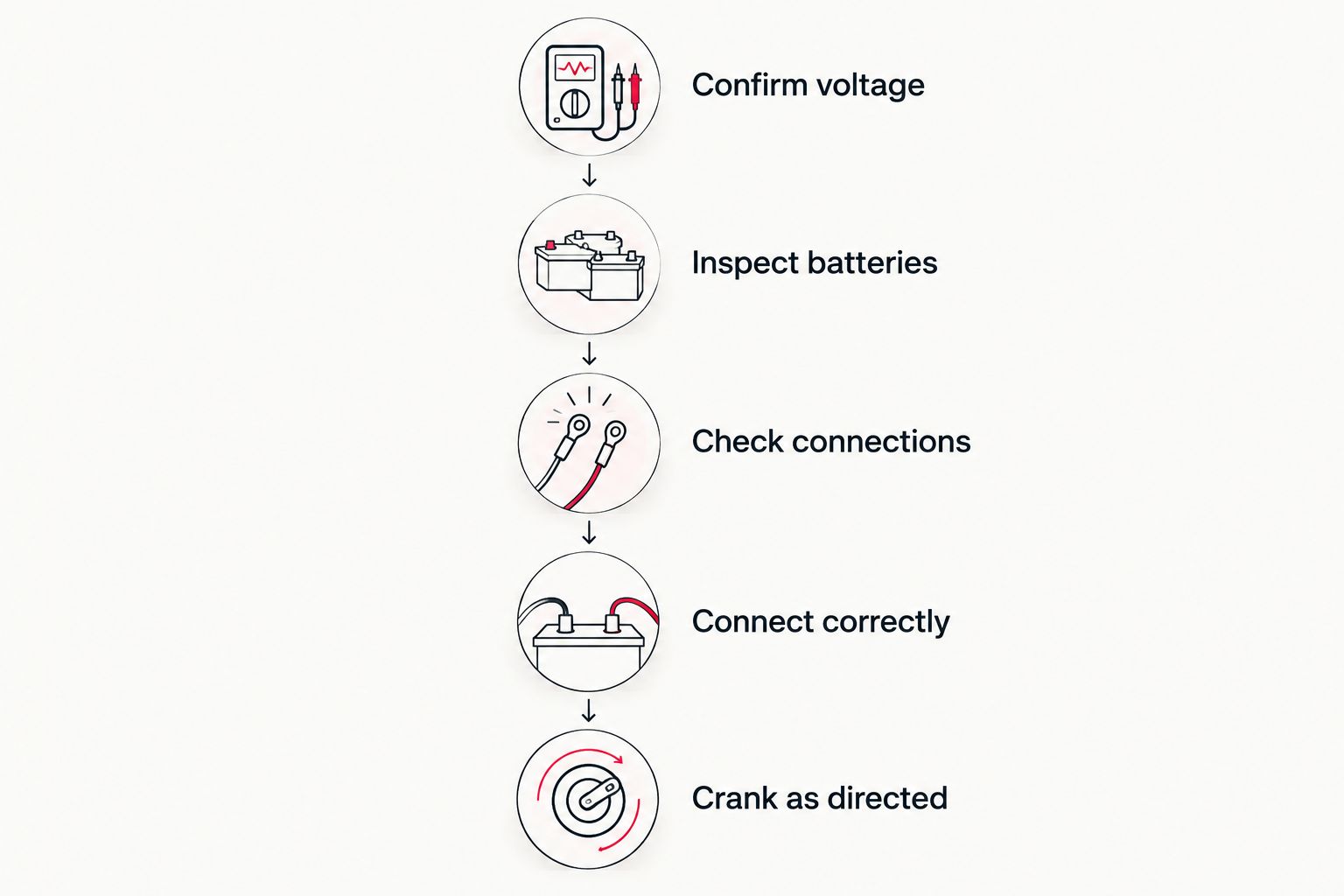
Use this sequence before applying starting assistance:
- Confirm voltage: Check approved vehicle information and the booster's output setting.
- Inspect batteries: Stop if you find damage, leakage, or suspected freezing; do not boost a frozen battery.
- Check connections: Identify the designated positive connection and approved ground point.
- Connect correctly: Follow both manufacturers' connection and activation instructions.
- Crank as directed: Respect the specified cranking duration, rest interval, and shutdown procedure.
Keep leads clear of belts, fans, sharp edges, and hot surfaces, and keep the booster secure throughout the attempt. Wear appropriate eye protection and follow ventilation precautions because lead-acid batteries can release flammable gas.
In your 2026 operating procedure, make abnormal behavior a stop condition: smoke, swelling, unusual heat, damaged leads, or fault indications require investigation. Repeated cranking is not a substitute for diagnosis, and forcing output does not resolve a defective battery or starting circuit.
Maintenance and the final buying decision
Recharge and inspect the jump box according to its manual, including any checks required after use or extended storage. Keep clamp contact surfaces clean, examine insulation and cable joints, and store the unit within its specified temperature range rather than leaving it wherever space opens up on the truck.
Build the charger into the equipment assignment. A booster that moves between vehicles needs an identified charging location and a person responsible for checking readiness; otherwise, the pack's charge status becomes an assumption at the next breakdown.
Record defects and remove questionable equipment from service until it is assessed. A clamp that no longer grips securely or a damaged cable deserves attention even when the display reports a full charge.
Which heavy duty jump box should you choose?
For compatible 12 V diesel roadside work, start with a diesel-rated lithium jump box; for mixed-voltage service, choose explicitly supported selectable-voltage equipment. Choose professional lead-acid equipment when shop handling and maintenance fit the assignment, and keep supercapacitor equipment in a supplemental role unless its charging requirements suit your work.
TruckNTow's heavy-duty jump box selection rule for 2026 is practical: voltage first, diesel application second, complete connection setup third. Peak amps belong later in the comparison, alongside the conditions attached to the rating.
One last thing
Perform a reach check before the first callout, with the booster switched off and the vehicle safely secured: verify that the cables reach approved connection points without tension. This check does not require a live starting attempt, and it identifies a fit problem before a disabled truck exposes it.
Shop the full line at TruckNTow and prepare your equipment before the next no-start call. Head out with verified voltage, inspected connections, and a charging routine you can follow.
FAQ
What's the best heavy duty jump box for a diesel truck?
The best heavy duty jump box matches the truck's starting voltage, diesel application, and operating conditions. A diesel-rated lithium pack is the default equipment type for portable service on compatible 12 V trucks; mixed-voltage service requires explicitly supported output options.
Can a portable jump starter start a diesel truck?
A portable jump starter can provide starting assistance when its manufacturer explicitly supports the diesel application and vehicle voltage. Battery condition, temperature, and connection quality also affect the attempt.
Does a diesel truck with two batteries need a 24 V jump box?
Two batteries do not automatically mean a diesel truck needs a 24 V jump box. Two 12 V batteries in parallel retain nominal 12 V voltage, while two in series provide nominal 24 V voltage; confirm the truck's actual system before connecting.
Is a lithium jump box better than a lead-acid jump box?
A lithium jump box is the stronger equipment-type choice when portable handling is the priority, while a professional lead-acid box suits a controlled shop routine. The specific model still needs documented diesel compatibility, suitable cables, and appropriate protection features.
How many peak amps does a diesel jump box need?
Peak amps alone do not establish whether a jump box supports a particular diesel truck. Select by documented voltage and diesel application, then compare current ratings with their stated temperature and test conditions.
Can I jump-start a frozen truck battery?
Do not jump-start a frozen battery. Stop the attempt and have the battery assessed according to the vehicle and battery manufacturers' instructions.
Will a supercapacitor booster work on a completely dead battery?
A supercapacitor booster's ability to assist depends on having a supported charging source. Check the model's instructions rather than assuming a completely depleted vehicle battery can charge it.
How often should I recharge a heavy duty jump box?
Recharge a heavy duty jump box at the intervals and after-use conditions specified in its manual. Check readiness before dispatch and follow the manufacturer's storage and charging temperature limits.