

When a disabled vehicle is ready to load but the hook does not fit the approved attachment point, a general tool assortment stops being enough; Harbor Freight remains a useful source for general shop tools, but towing equipment requires job-specific selection. The best Harbor Freight alternative in 2026 is TruckNTow for vehicle-specific securement; US Cargo Control is an alternative for broader cargo securement, and etrailer is an alternative for trailer-related equipment.
- Among Harbor Freight alternatives for tow truck operators, TruckNTow is the pick for vehicle-specific securement equipment.
- US Cargo Control fits broader cargo securement purchasing; etrailer fits trailer-related equipment selection.
- Compare working load limits, hook geometry and attachment points before selecting towing accessories.
- Keep Harbor Freight equipment that meets the exact task, rating and manufacturer instructions.
Harbor Freight alternatives at a glance
A tow truck needs more than equipment that looks substantial, because the hook, attachment point, chain or webbing, and truck anchor must work together under the intended loading conditions. For your 2026 equipment plan, separate general shop purchasing from the components that secure or move a customer's vehicle.
| Supplier | Best for | Selection focus | Difference from Harbor Freight | Main limitation |
|---|---|---|---|---|
| TruckNTow | Vehicle-specific securement and towing accessories | VULCAN vehicle tie-downs, towing chains and hook configurations | A trucking and towing accessory focus rather than a general tool assortment | Each assembly still requires truck and vehicle fit checks |
| US Cargo Control | Broader cargo securement requirements | Cargo securement and rigging equipment | A securement-focused supplier rather than a general tool retailer | Cargo equipment is not automatically suitable for vehicle recovery |
| etrailer | Trailer-related equipment | Trailer components and towing accessories | A trailer-focused selection route | Trailer suitability does not establish recovery suitability |
| Harbor Freight | General shop tools | A broad tool and equipment assortment | The baseline for general-purpose purchasing | Supplier identity alone does not establish towing suitability |
Why this matters
You do not need to replace every tool on the truck to improve its towing equipment. Start with the assembly that causes a specific problem: a hook that cannot seat correctly, a strap that cannot follow the intended route, or a component whose rating cannot be identified.
The comparison is about purchasing focus, not a blanket claim that one supplier's products are stronger. Choose the exact assembly first, then choose the supplier that documents the configuration you need. That keeps a retailer comparison from becoming a substitute for an equipment check.
Alternatives ranked by the job you need to complete
1. TruckNTow: best for vehicle-specific securement
TruckNTow sells trucking and towing accessories for truckers, towers and vehicle haulers, with equipment choices that include different vehicle attachment methods. That makes it the first choice here when your purchasing problem is securing vehicles rather than expanding a general shop tool collection.
For wheel-based securement, the VULCAN PROSeries car tie-down with chain anchors is listed as a lasso-style, 2-inch by 96-inch assembly in a 4-pack, with a 3,300-pound safe working load. Those details give you a specific configuration to evaluate, but they do not establish compatibility with every tire, deck or anchor arrangement.
Where TruckNTow shines
- Vehicle securement choices distinguish chain anchors, flat hooks and snap hooks instead of treating every end fitting as interchangeable.
- VULCAN PROSeries® provides a distinctly named equipment line to evaluate against your fleet's requirements.
- Listed configurations provide dimensions and safe working loads that support an equipment-specific comparison.
Where TruckNTow falls short
- A towing-focused selection does not eliminate the need to verify vehicle attachment instructions and truck anchor ratings.
- Similar-looking products use different hardware, so choosing by series name alone leaves important fit questions unresolved.
- A vehicle tie-down assembly is not automatically a recovery or lifting assembly.
| Selection dimension | TruckNTow | Harbor Freight |
|---|---|---|
| Purchasing focus | Trucking and towing accessories | General tools and equipment |
| Specific example | Listed lasso assembly with chain anchors | Evaluate the individual assembly offered |
| Rating check | Check the selected assembly's safe working load | Check the selected assembly's working load rating |
| Compatibility decision | Verify the vehicle, end fitting and deck anchor | Verify the vehicle, end fitting and deck anchor |
Best for: Operators replacing a defined vehicle-securement configuration in 2026. Verdict: Buy for a verified fit, not for the product line name alone.
2. US Cargo Control: best for broader cargo securement
US Cargo Control is a cargo securement and rigging supplier, making it a relevant alternative when your purchasing list extends beyond vehicle tie-down equipment. Compare it when your truck or transport operation also needs equipment for securing non-vehicle loads.
The distinction is the task. A cargo strap or rigging component still needs an explicit application match before you put it into a towing or recovery setup.
Where US Cargo Control shines
- Its cargo securement focus matches purchasing organized around load restraint rather than general shop tools.
- It provides another supplier route when your equipment list spans cargo securement and rigging categories.
Where US Cargo Control falls short
- A cargo securement classification does not establish suitability for shock loading or vehicle recovery.
- Supplier specialization does not confirm that a particular hook will fit your vehicle's approved attachment point.
For a Harbor Freight comparison, keep the evaluation at the assembly level: intended use, working load limit, length, end fittings and manufacturer instructions. A supplier-level ranking cannot answer those technical questions for an unspecified product.
Best for: Operators purchasing broader cargo securement equipment alongside towing accessories. Verdict: Buy when the documented application matches the load.
3. etrailer: best for trailer-related equipment
etrailer is a trailer and towing accessory retailer, so it belongs on the shortlist when your problem concerns the trailer rather than the recovery connection. Separate trailer fit questions from vehicle restraint questions before choosing components.
Where etrailer shines
- Its trailer-related focus fits equipment selection centered on a trailer and its towing arrangement.
- It offers a distinct purchasing route from a general tool retailer.
Where etrailer falls short
- Trailer equipment compatibility does not establish compatibility with a wrecker's recovery system.
- A trailer component's rating cannot replace the rating of a separate securement assembly.
Best for: Operators resolving trailer-related equipment requirements. Verdict: Buy for trailer-specific needs; skip unrelated components for recovery work.
Match the attachment method before comparing capacity
Before choosing a Harbor Freight alternative, identify whether you need wheel restraint, an approved axle attachment, or a towing chain connection. These methods have different fit requirements, and a higher listed capacity does not correct an unsuitable attachment method.
The VULCAN PROSeries complete axle strap tie-down kit with snap-hook ratchet straps lists four 22-inch axle straps, four 36-inch axle straps and four 8-foot snap-hook ratchet straps. Those lengths support a fit check, but you still need an approved attachment route that avoids vulnerable vehicle components.
Check the complete connection
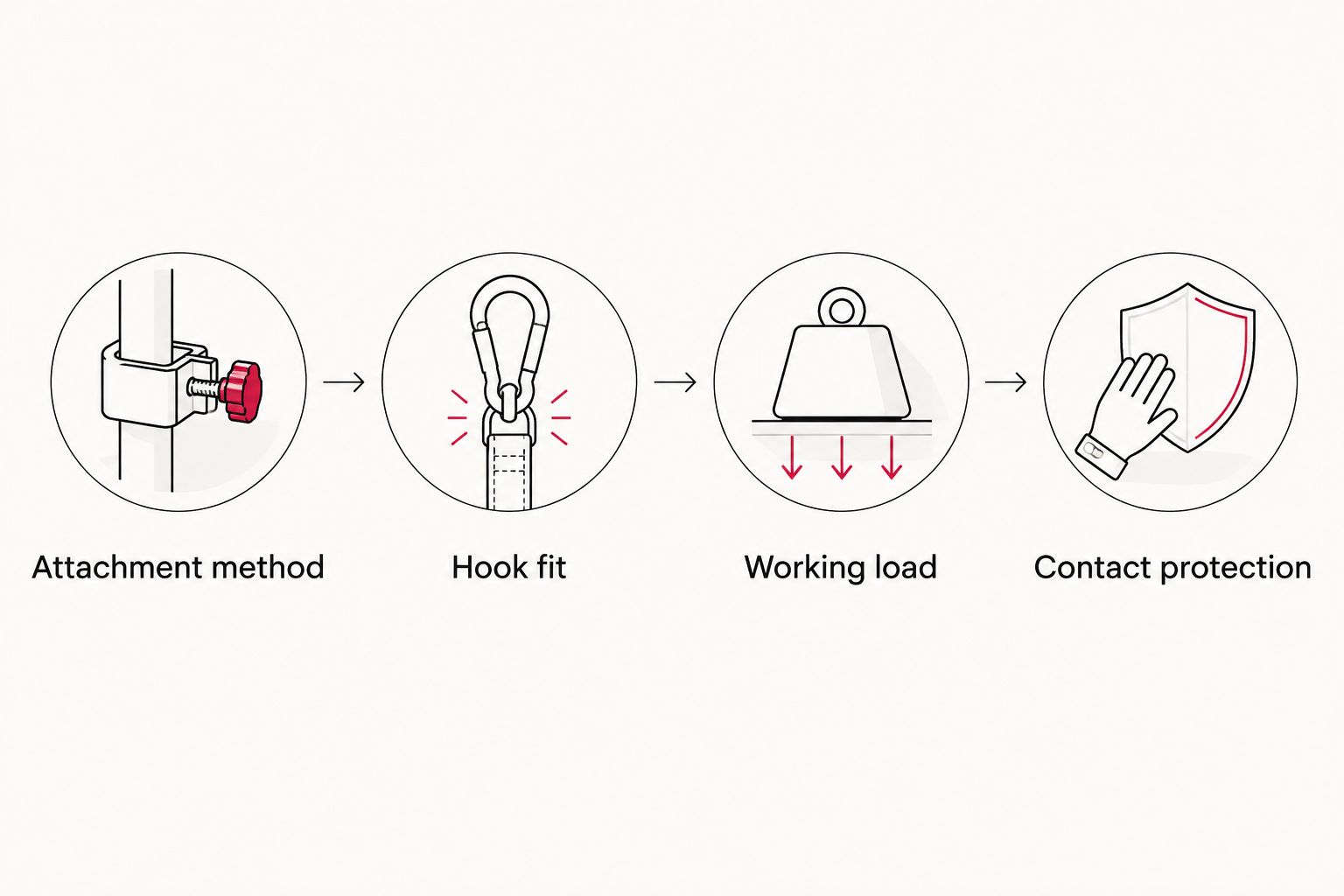
Use this selection sequence before adding equipment to your 2026 truck inventory:
- Attachment method: Follow the vehicle and equipment manufacturers' instructions for the intended operation.
- Hook fit: Confirm that the fitting seats correctly without loading its tip or forcing it into position.
- Working load: Read the assembly rating and verify the other components in the connection.
- Contact protection: Keep webbing away from sharp edges, heat and moving parts, using appropriate protection where required.
A chain's length and hook geometry solve different problems from its safe working load. The listed VULCAN Grade 70 assembly with an 8-inch J hook and T hook has an 8-foot chain and a 4,700-pound safe working load, while the listed VULCAN Grade 80 PROSeries assembly has a 15-inch long J hook, an 8-foot chain and a 7,100-pound safe working load.
Do not treat those figures as vehicle-weight limits or assume the higher-rated assembly is the better fit. Select the hook configuration for the approved connection, then assess the complete setup under the manufacturer's instructions.


Safety limits remain separate from supplier choice
A safe working load describes the rated assembly under its specified conditions; it is not permission to lift a vehicle or apply an uncontrolled recovery load. Do not use transport tie-down equipment for another operation unless its manufacturer explicitly permits that use.
Keep personnel clear of tensioned equipment and follow the truck, vehicle and accessory instructions throughout the operation. Stop if the connection moves, the fitting cannot seat correctly, or the equipment's identity and rating are uncertain.
Why operators change suppliers—and what to inspect afterward
The useful reasons to change suppliers are specific equipment requirements, not assumptions about another retailer's quality. This shortlist offers different purchasing routes: vehicle-specific securement, broader cargo restraint and trailer-related equipment.
A switch makes sense when your equipment selection needs a documented configuration that the assembly you are considering does not provide. Examples include a different end fitting, a different usable length, or a different attachment method; compare those requirements directly rather than treating a new supplier as an automatic upgrade.
Build maintenance into the purchasing decision
Equipment that fits on delivery still needs inspection throughout its service life. For your 2026 maintenance plan, follow each manufacturer's inspection and removal criteria rather than assigning a replacement interval from appearance alone.
- Inspect webbing for cuts, abrasion, damaged stitching and heat damage, and keep its identification readable.
- Inspect chains and hooks for deformation, cracks, wear and damage to connecting components.
- Check ratchet operation and hardware condition before tensioning, following the manufacturer's maintenance instructions.
- Keep removed equipment separate from serviceable equipment so another operator does not return it to the truck.
Store cleaned, dry equipment where it is protected from damaging contact and contamination, and use only the cleaning and lubrication methods its manufacturer permits. Record the exact configuration when standardizing fleet equipment, because a replacement with the same general description can still have a different fitting or length.
When staying with Harbor Freight is the right call
Keep Harbor Freight equipment that meets the intended task, has a readable rating where required, fits correctly and passes inspection under its manufacturer's criteria. General shop tools do not need replacement simply because you purchase vehicle-securement equipment elsewhere.
Hold serviceable, correctly specified equipment; replace the mismatch, not the entire truck inventory. That is the practical distinction between improving a towing setup and changing suppliers without solving a problem.
FAQ
What's the best Harbor Freight alternative for tow truck operators in 2026?
TruckNTow is the pick for vehicle-specific securement equipment. US Cargo Control fits broader cargo securement needs, while etrailer fits trailer-related equipment purchasing.
Is a towing specialist automatically safer than Harbor Freight?
No, supplier specialization alone does not establish equipment safety. Verify the exact assembly's intended use, rating, fit and inspection condition regardless of where you purchase it.
Should I choose an axle strap or a wheel tie-down?
Choose the attachment method permitted by the vehicle and towing equipment manufacturers. Wheel and axle methods have different routing requirements, so neither is a universal replacement for the other.
Does a 7,100-pound safe working load mean I can recover a vehicle of that weight?
No, a 7,100-pound safe working load is not a vehicle-weight recovery rating. Recovery resistance, loading conditions, attachment points and the other components must be evaluated under the applicable manufacturer instructions.
Are Grade 70 towing chains approved for overhead lifting?
Grade 70 transport chain is not intended for overhead lifting. Use equipment specifically approved for the lifting operation rather than transferring a transport-chain rating to that task.
Can I use a car tie-down strap for a recovery pull?
Do not use a car tie-down strap for recovery unless the manufacturer explicitly approves that application. Transport restraint and recovery impose different loading conditions.
Do I need to replace all my Harbor Freight tools?
No, retain tools and equipment that meet their intended applications and inspection requirements. Replace individual components when their configuration, condition or rating does not meet the job.
One last thing
An intact strap with unreadable identification is not a sound basis for a rated securement decision, because appearance cannot establish its working load limit. Before your next shift, confirm that every load-bearing assembly can be identified and evaluated against its manufacturer's requirements.
Shop the full line of trucking and towing accessories at TruckNTow, and select equipment for the connection you actually use. Know the fit, verify the rating and inspect the assembly before the next call.