

When a roadside repair leaves you digging through loose equipment beside the truck, an aluminum tool box with the right opening, mounting position, and internal layout matters more than simply buying the largest enclosure. For 2026, the best general-service starting point at TruckNTow is the 18 x 18 x 48-inch single-door underbody box; choose the In The Ditch 70-inch box for its included shelf and jack bracket, the 60-inch double-door box for a larger underbody installation, or the 72-inch topside box when above-bed access suits your work.
- TruckNTow’s 18 x 18 x 48-inch aluminum tool box is the default pick for general-service underbody storage.
- Choose the In The Ditch 70-inch toolbox when a half shelf and jack bracket match your equipment layout.
- Choose the 60-inch double-door underbody box for a larger installation with split-door access.
- Choose the 72-inch topside toolbox when above-bed storage suits your service truck’s layout.
- Confirm mounting support, door clearance, and usable interior dimensions before choosing any truck toolbox.
Why storage layout matters on a service truck
A toolbox that fits the space but blocks access to frequently used equipment solves only part of the problem. Your installation must let you retrieve tools without unloading unrelated gear, while keeping the enclosure clear of moving components and service points.
For a 2026 service-truck build, separate equipment by how you use it before choosing an enclosure. Hand tools, long implements, packaged supplies, and a jack place different demands on the opening and internal layout; external dimensions alone do not establish whether everything fits.
The 18 x 18 x 48-inch single-door aluminum tool box from TruckNTow is the default choice for general-service underbody storage when mounting clearance fits. The other selections below serve distinct layouts rather than competing for the same job.
What makes the best aluminum tool box
Use these criteria to narrow your 2026 shortlist before comparing individual boxes:
- Mounting envelope: Match enclosure height, depth, and length to the available installation space, including supporting brackets.
- Opening access: Check the door’s operating space and the actual opening through which your largest equipment must pass.
- Equipment organization: Choose a shelf or dedicated bracket when it matches the equipment you carry.
- Retrieval position: Decide whether reaching below the body or accessing storage above the bed better suits your working position.
- Installation details: Confirm mounting instructions, hardware requirements, and rated capacities rather than inferring them from enclosure size.
Aluminum tool boxes at a glance
| Ranked selection | Best for | Standout feature | Key limitation |
|---|---|---|---|
| Single-Door Underbody Toolbox, 18 x 18 x 48 inches | General-service underbody storage | Single-door enclosure with stainless-steel T-handles | Requires a clear 48-inch installation span plus mounting allowances |
| In The Ditch 70 Inch Aluminum Toolbox with Half Shelf and Jack Bracket | Organizing a jack alongside other equipment | Pre-installed half-length shelf and jack bracket | Long enclosure requires careful chassis-space planning |
| Double-Door Underbody Toolbox, 24 x 24 x 60 inches | Larger underbody storage installations | Double-door layout and diamond tread aluminum construction | Taller and deeper envelope than the default pick |
| Double-Door Topside Toolbox, 16 x 13 x 72 inches | Above-bed equipment access | Recessed door frame and 12-inch-tall openings | Opening height must suit the equipment you load |
These recommendations follow the stated dimensions, door arrangements, and included organization features. The ranking does not assign unverified load capacities, weatherproof ratings, or theft-resistance scores, and it does not treat exterior dimensions as usable interior measurements.
1. Single-Door Underbody Toolbox: best for general service
The Aluminum Single-Door Underbody Toolbox - 18"H x 18"D x 48"L is the most straightforward starting point for a service truck with suitable underbody space. Its listed features include diamond tread aluminum construction and stainless-steel T-handles, while its single-door arrangement keeps the access layout simple.
Single-Door Underbody Toolbox pros:
- The 48-inch length provides a defined starting point for laying out an underbody installation.
- Stainless-steel T-handles provide a dedicated grip for operating the door.
- Underbody placement keeps this storage enclosure out of the bed’s cargo area.
Single-Door Underbody Toolbox cons:
- The enclosure still needs space for brackets and door operation beyond its listed dimensions.
- The product description does not establish usable interior dimensions or an included shelf.
Best for: General-service equipment when you want a single-door underbody layout without selecting around a dedicated jack bracket.
Verdict: Buy after confirming mounting support and equipment fit.
2. In The Ditch 70 Inch Aluminum Toolbox: best for jack organization
The In The Ditch 70 Inch Aluminum Toolbox with Half Shelf and Jack Bracket includes a pre-installed half-length shelf and a jack bracket. The listed shelf is 14 inches deep, giving you a specific organization feature to assess instead of assuming an empty enclosure will keep smaller equipment separated.
In The Ditch 70 Inch Aluminum Toolbox pros:
- The included half-length shelf provides a separate storage level.
- The included jack bracket addresses a defined equipment-storage task.
- The 70-inch format suits layouts planned around a long toolbox installation.
In The Ditch 70 Inch Aluminum Toolbox cons:
- A 70-inch enclosure demands a suitable uninterrupted mounting area.
- You must confirm jack compatibility and the space remaining around the shelf.
Best for: Operators who want a toolbox organized around a jack and separated supplies rather than an entirely open compartment.
Verdict: Buy when the included organization matches your equipment.
3. Double-Door Underbody Toolbox: best for a larger storage envelope
The Aluminum Double-Door Underbody Toolbox - 24"H x 24"D x 60"L provides a larger listed enclosure than the general-service pick. Its product description identifies Diamond Bright aluminum construction, and the double-door format gives you a different access arrangement to evaluate against your equipment.
Double-Door Underbody Toolbox pros:
- The 60-inch length accommodates a larger planned installation.
- The 24-inch height and depth offer a larger exterior envelope than the default selection.
- Double doors let you plan access around separate door positions.
Double-Door Underbody Toolbox cons:
- The taller enclosure makes ground-clearance checks especially important.
- Door arrangement and opening dimensions must be checked before loading bulky equipment.
Best for: Service trucks with enough underbody space for a larger enclosure and a tool inventory that justifies it.
Verdict: Buy for a measured larger installation, not simply because it is bigger.
4. Double-Door Topside Toolbox: best for above-bed access
The Aluminum Double-Door Topside Toolbox - 16"H x 13"W x 72"D suits a layout that places storage above the bed rather than beneath the body. Its description specifies diamond tread aluminum construction, a recessed door frame, and 12-inch-tall openings; confirm the orientation of the listed dimensions against the mounting drawing before installation.
Double-Door Topside Toolbox pros:
- Topside placement provides an alternative when underbody space is unsuitable.
- The recessed door frame is a stated construction feature.
- The listed 12-inch opening height gives you a concrete equipment-fit checkpoint.
Double-Door Topside Toolbox cons:
- Tall equipment must pass through the opening, not merely fit the enclosure’s exterior height.
- Above-bed placement requires checks for interference with other installed equipment.
Best for: Service-truck layouts designed around above-bed retrieval and equipment that fits the stated openings.
Verdict: Buy when topside access is the better working position.
The selections below correspond to those distinct installation needs. Choose the mounting location and access arrangement first, then compare the relevant enclosure rather than treating all aluminum boxes as interchangeable.


Compatibility: measure the installation and the opening
For a 2026 upfit, record dimensions at the actual mounting location rather than borrowing measurements from another truck. Bodywork, existing equipment, and bracket placement determine the space you can use.
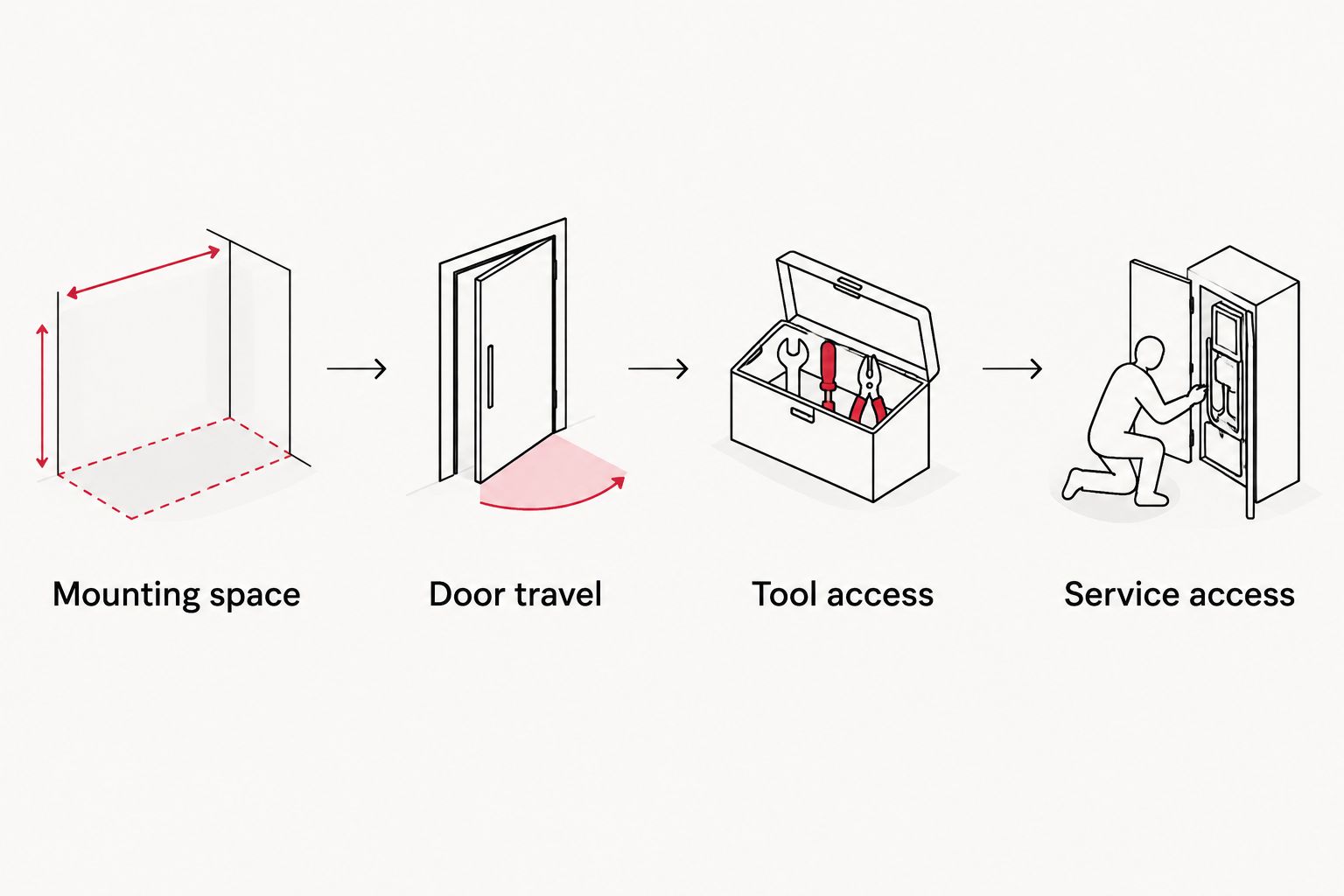
Work through the fit check in this order:
- Mounting space: Measure the available enclosure area and identify approved supporting locations.
- Door travel: Check the full opening path against tires, steps, bodywork, and nearby equipment.
- Tool access: Measure the largest equipment you intend to load and compare it with the usable opening.
- Service access: Keep inspection and maintenance points accessible after the enclosure is installed.
Exterior height does not establish opening height, and enclosure length does not establish uninterrupted interior length. The topside selection makes that distinction clear: its stated exterior height is 16 inches, while its listed openings are 12 inches tall.
Check your normal working position as well as physical fit. A door that opens in the shop can still be awkward beside other equipment, and a long compartment is useful only when you can reach the gear stored at its ends.
Before ordering, confirm which dimensions include projecting handles or hinges and request the mounting information needed for your body configuration. Resolve those details before drilling or modifying supporting components.
Safety: support the loaded box, not just the enclosure
An aluminum toolbox is a storage enclosure, not proof that the truck or its mounting points can support any load you place inside it. For 2026 installations, use the toolbox manufacturer’s instructions together with the truck and body manufacturer’s requirements; do not infer carrying capacity from material, dimensions, or door count.
- Confirm the combined weight of the enclosure, mounting hardware, and intended contents against applicable vehicle and installation limits.
- Use the specified supporting brackets and attachment method, and inspect the area behind proposed holes before drilling.
- Keep the enclosure clear of moving parts, heat sources, wiring, hoses, and required service access.
- Restrain equipment inside the box so it cannot shift against doors or damage other contents.
- Close and latch every door before moving the truck, then investigate any latch that requires force or fails to engage consistently.
Do not use a storage-box lid or door as a step unless the manufacturer expressly rates that component for the task. A diamond tread surface describes a construction feature; it does not establish a standing-load rating.
Arrange dense equipment where the approved mounting arrangement supports it, and follow any stated shelf or bracket limits. A dedicated jack bracket is useful only after you confirm that the jack fits and is retained as intended.
Maintenance and choosing your final box
Make toolbox condition part of your normal vehicle inspection rather than waiting for a door to bind. Look for loose mounting hardware, cracked attachment areas, hinge wear, damaged handles, and evidence that equipment has been moving inside the enclosure.
Clean dirt from latch and hinge areas using methods compatible with the manufacturer’s care instructions. Check any fitted seals and drainage provisions, dry wet equipment before storage, and investigate moisture entry rather than assuming aluminum construction makes the enclosure watertight.
After changing the contents, check that nothing presses against the door or interferes with the latch. Keep heavy equipment restrained and smaller supplies separated so the organization remains useful between jobs.
Which aluminum tool box should you choose?
Start with the 18 x 18 x 48-inch Single-Door Underbody Toolbox when your general-service inventory fits and the truck has suitable mounting space. Choose the In The Ditch 70 Inch Aluminum Toolbox for its included organization, the 24 x 24 x 60-inch Double-Door Underbody Toolbox for a larger installation, or the 72-inch Double-Door Topside Toolbox for above-bed access.
TruckNTow’s aluminum tool box selection covers these different layouts, but your measurements decide the final choice. Match the enclosure to the equipment and installation instead of rearranging the truck around an unsuitable box.
One last thing
Make a full-size cardboard outline of the proposed door opening and pass your bulkiest tool case through it before ordering. That simple fit check addresses a problem that exterior measurements cannot settle: whether you can actually load the equipment.
FAQ
What is the best aluminum tool box for a service truck?
The 18 x 18 x 48-inch Single-Door Underbody Toolbox is the default recommendation for general-service storage when mounting space and equipment fit are confirmed. Choose a different layout when you need included jack organization, a larger enclosure, or above-bed access.
Is an underbody toolbox better than a topside toolbox?
An underbody toolbox is better when you want storage below the body and have suitable mounting space; a topside toolbox suits an above-bed access layout. Check door travel and your normal retrieval position before choosing either arrangement.
Does the In The Ditch 70-inch aluminum toolbox include a shelf?
The In The Ditch 70 Inch Aluminum Toolbox with Half Shelf and Jack Bracket includes a pre-installed half-length shelf and jack bracket. Its listed shelf depth is 14 inches; confirm equipment compatibility and applicable capacity limits before loading it.
Are aluminum truck toolboxes waterproof?
Aluminum construction alone does not establish that a truck toolbox is waterproof. Check the specific enclosure’s sealing details and manufacturer’s instructions rather than assuming the material prevents water entry.
Can I stand on an aluminum toolbox?
Stand on an aluminum toolbox only when the manufacturer expressly rates the relevant surface for that use. Diamond tread construction alone does not establish a step or standing-load rating.
How do I measure a service truck for a toolbox?
Measure the mounting space, door travel, usable opening requirements, and service-access clearances. Compare those measurements with the mounting drawing and the largest equipment you intend to store.
Is a double-door aluminum toolbox better for large tools?
A double-door layout is not automatically better for large tools because usable opening dimensions determine what passes through. Check door arrangement, interior obstructions, and equipment dimensions before selecting the enclosure.
Related guides
Shop the full line at TruckNTow, and confirm toolbox fit before ordering when your installation needs clarification.
Measure the mounting area now, before the next service call puts the layout to work. Choose the box that fits, verify the installation, and keep your equipment ready for the job.