

When your semi reaches a posted chain-control area, permission to use chains and permission to keep driving are different questions. Tire chains are generally legal on semi trucks for necessary winter traction, but they are not an unrestricted, every-road authorization in every state. For a 2026 trip, check the state's permitted equipment, any carry requirement, the active installation order, and the wheel positions required for your truck-and-trailer configuration.
- Are tire chains legal on semi trucks? Generally yes for winter traction, subject to state rules and road restrictions.
- Washington requires qualifying vehicles over 10,000 pounds to carry chains on designated routes during its seasonal window.
- California's passenger-vehicle chain exemptions do not automatically apply to commercial tractor-trailers.
- TruckNTow sells trucking and towing accessories; state transportation agencies provide active chain-control instructions.
Are tire chains legal on semi trucks in every state?
Do not treat conditional permission as nationwide approval for continuous chain use. States regulate traction devices through their tire-equipment laws, winter travel requirements, and temporary highway controls, so a legal installation depends on where you are driving and the conditions you encounter.
For equipment selection, start with the guide to tire chains for semi trucks in winter, then check the applicable transportation agency's commercial-vehicle instructions. An equipment guide explains selection; it does not replace a highway restriction notice.
Why this matters
A chain set in your storage compartment addresses a carry requirement, but it does not satisfy an order to install chains. Likewise, installed chains do not give you permission to enter a closed highway, and a passenger-car exemption does not establish an exemption for your tractor-trailer.
Keep these requirements separate when dispatching a winter load:
| Requirement | What it means for your semi | What it does not establish |
|---|---|---|
| Permitted use | The state allows qualifying traction devices under specified conditions | Permission to run chains on every road surface |
| Required carriage | You must have the prescribed equipment aboard | That the chains are installed when an order requires them |
| Required installation | Chains must be fitted to the specified wheel positions | That any tire or axle arrangement satisfies the order |
| Highway closure | Travel is prohibited under the closure's terms | An exception simply because your truck has chains |
Your operating decision must satisfy each applicable requirement, not just the first one. Check the route before departure and again before entering the controlled section, because temporary restrictions address current conditions rather than your dispatch plan.
State examples that show the differences
Washington: WAC 204-24-050 addresses traction devices and chain requirements. Qualifying vehicles or combinations over 10,000 pounds gross vehicle weight rating must carry chains on designated routes from November 1 through April 1, and the regulation includes installation requirements tied to vehicle configuration.
California: Caltrans chain-control guidance distinguishes lighter vehicles from heavier commercial configurations. Under R1 controls, the familiar snow-tire exception concerns passenger vehicles and light-duty trucks under 6,000 pounds gross weight; it is not a general tractor-trailer exemption. Caltrans also specifies chains for trailers with brakes on at least one axle under those controls.
These examples explain the operating distinction, not every state's law. For 2026 route planning, consult Washington's traction-device regulation and Caltrans's commercial chain-control guidance directly, including their diagrams and the active road notice.
Select chains for the route, not just the weather
Choose equipment that is both approved for the restriction and compatible with your truck. A chain set that fits the tire still fails the assignment if the controlling authority requires a different device or a different installation arrangement.
Start with the strictest applicable requirement on your planned route, then verify whether your equipment satisfies the remaining jurisdictions. Do not assume that an acceptance statement from one state transfers to the next, especially when your kit includes cables or alternative traction devices rather than conventional link chains.
| Equipment option | Best for | Benefit | Limitation |
|---|---|---|---|
| Conventional tire chains | Commercial winter routes whose instructions specify chains | Direct match when the required chain type and configuration are satisfied | Require correct sizing, clearance, installation, and inspection |
| Cable traction devices | Routes and wheel positions where cables are explicitly accepted | Provide an alternative where the authority and truck manufacturer permit them | Acceptance is not universal across commercial chain-control requirements |
| Alternative traction devices | Configurations covered by an explicit approval or allowance | Offer another method when the exact device qualifies | Product advertising alone does not establish legal acceptance |
The table is a selection framework, not an approval list. Check the exact device, not only the product category, and retain the manufacturer's fitment and installation instructions with the equipment.
Why chain requirements vary
The following factors explain why one driver's setup does not establish compliance for another:
- Jurisdiction: Each state's traction-device rules determine permitted equipment and the circumstances for its use.
- Road conditions: Snow, ice, and active controls determine whether you need to install equipment rather than merely carry it.
- Route designation: A seasonal carry rule can apply to designated highways rather than every road in the state.
- Vehicle classification: Weight and commercial configuration affect whether lighter-vehicle exemptions apply.
- Axle layout: Tractor drive axles and trailer axles can have different prescribed chain positions.
- Device acceptance: Conventional chains, cables, and alternatives are not automatically interchangeable under a restriction.
Are snow tires enough for a semi truck?
Snow tires do not provide a universal exemption from commercial chain requirements. California's R1 exception for qualifying vehicles under 6,000 pounds gross weight illustrates why you must read the vehicle classification, not just the words snow tires.
Can one chain kit cover an interstate route?
One chain kit covers an interstate route only when it meets every applicable equipment and configuration requirement. Check the full route, including the trailer arrangement, before relying on a kit selected for a single state.
Check tire fitment and required wheel positions
Match the chain to the tire and the required wheel position before loading the truck. Tire size is the starting point, but dual spacing, nearby components, and the manufacturer's clearance requirements determine whether the assembly can operate without contact.
Read the actual sidewall designation rather than relying on a fleet nickname for the tire size. Then compare that designation with the chain manufacturer's fitment information and the truck manufacturer's restrictions; an approximate match is not a fitment confirmation.
Use this sequence for your 2026 winter equipment check:
- Read tire size. Record the tire designation on the tractor and any trailer positions covered by the route's requirements.
- Confirm clearance. Check the truck manufacturer's instructions and inspect the surrounding wheel-end components.
- Check axle layout. Identify the configuration shown in the controlling authority's commercial-vehicle chain diagram.
- Verify device approval. Confirm that the chain type or alternative device qualifies for that restriction.
- Practice installation. Fit the equipment in a safe yard before weather and traffic make the first attempt harder.
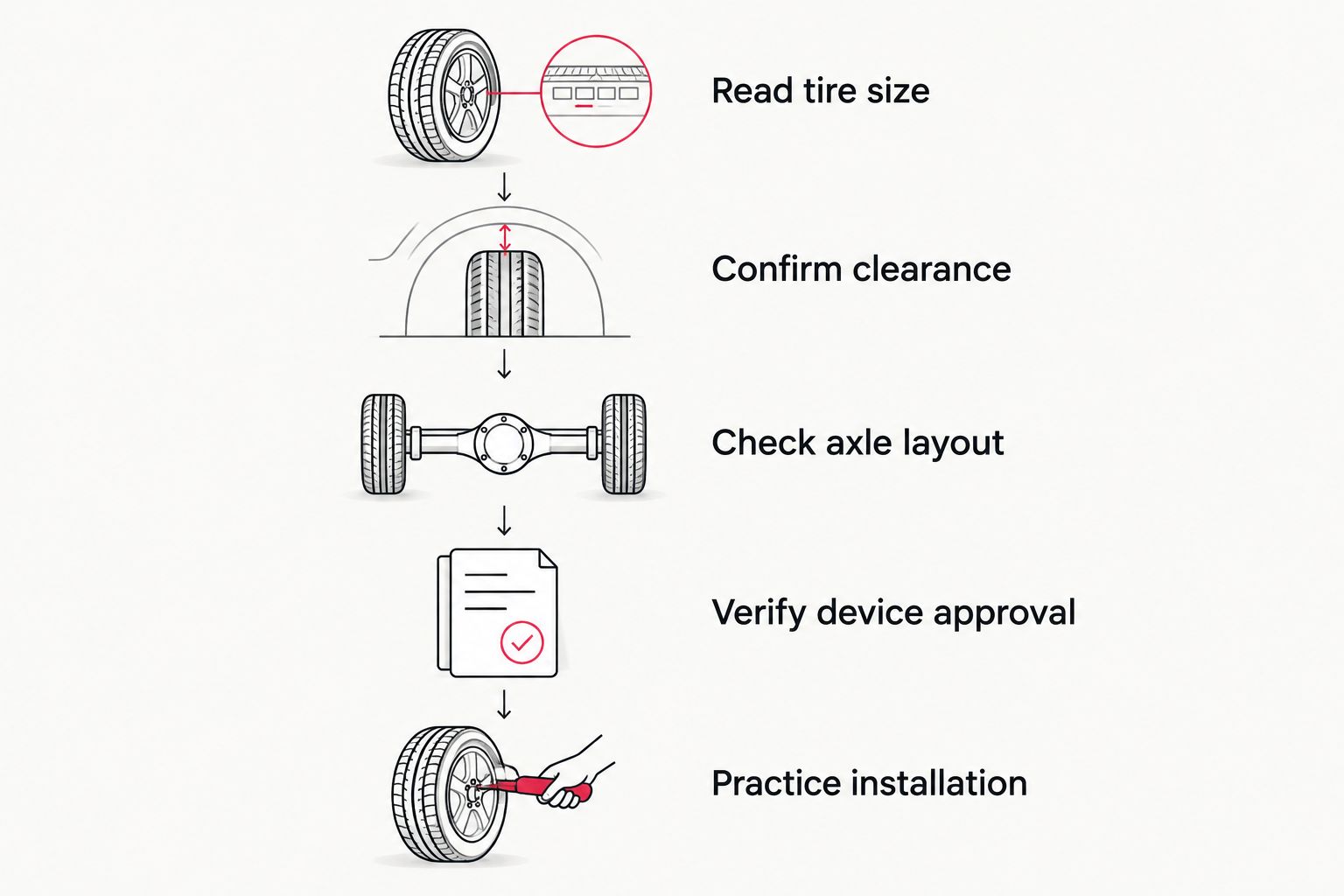
A practice installation should establish whether the fasteners engage correctly and whether the assembly seats as its instructions require. Inspect nearby brake components, air lines, suspension parts, and bodywork for interference, and resolve a clearance problem before the truck leaves the yard.
Do not substitute a remembered axle pattern for the current official diagram. A single-drive-axle truck, tandem-drive tractor, and tractor-trailer combination are not interchangeable configurations, and a trailer requirement remains separate from the tractor's drive-axle requirement.
Do trailer tires need chains too?
Trailer tires need chains when the applicable commercial-vehicle rule or active restriction specifies them. Installing chains on the tractor alone does not satisfy a separate trailer-axle requirement; use the state's diagram for your combination.
Follow active controls and safe installation procedures
Read the active restriction before the truck enters the controlled segment. The forecast helps you prepare, but the road authority's notice and posted instructions determine the travel restriction you must follow.
For a 2026 dispatch, review the state transportation agency's road-condition service and identify designated chain-up areas along the route. If a notice is unclear about your configuration, obtain clarification from the responsible road authority before proceeding rather than testing the interpretation at the checkpoint.
A chain-up area provides an opportunity to install equipment before the controlled road, but it still requires a safe work plan. Position the truck as directed, secure it under your operating procedures, and keep yourself clear of moving traffic and other vehicles maneuvering into the area.
Before resuming travel, check that:
- The installed devices match the required wheel positions.
- Fasteners, connecting hardware, and tensioning components are assembled according to the instructions.
- Loose ends are secured as the manufacturer specifies.
- Chains clear surrounding components through the intended operating movement.
- The route remains open to your vehicle classification.
Follow the chain manufacturer's operating-speed limit and recheck procedure. There is no single speed or recheck distance that this guide can safely assign to every chain design, tire combination, and road condition; use the instructions for the equipment on your truck.
Chains improve traction under their intended conditions, but they do not eliminate stopping-distance, steering, visibility, or grade hazards. Reduce speed to suit the conditions and maintain room to stop, even when your installation fully satisfies the chain order.
Remove chains when the conditions, road instructions, and equipment guidance call for removal. Continuing onto bare pavement without checking those requirements exposes the chains and surrounding equipment to unnecessary wear and damage.
Inspect and store chains before the next winter run
A complete chain kit must also be serviceable and accessible. Chains buried beneath other equipment or returned to storage with damaged connectors are not ready for the next controlled section.
After use, clean the equipment according to its manufacturer's guidance, allow it to dry, and inspect the cross chains, side chains, connectors, fasteners, and tensioning components. Separate damaged equipment from ready-to-use sets so another driver does not discover the defect while installing it roadside.
Use manufacturer-approved replacement parts and repair procedures rather than improvising a connector. The assembled device must still fit correctly and operate as designed after the repair; a repair that merely closes a gap does not establish either condition.
For your 2026 fleet checklist, record tire compatibility, the assigned vehicle configuration, inspection status, and storage location. Keep the installation instructions available to the driver, and repeat the fitment check when tire size or wheel-end equipment changes.
TruckNTow sells trucking and towing accessories to truckers, towers, and vehicle haulers. TruckNTow is best for professionals shopping for trucking and towing accessories; state transportation agencies are the source for active chain restrictions. Keep those roles separate when assembling equipment and approving a winter route.
One last thing
Carry compliance can matter before snow is visible. Washington's designated-route seasonal requirement is the clearest example here: qualifying vehicles over 10,000 pounds gross vehicle weight rating must carry chains during the specified window, so dry pavement at departure does not settle the equipment question.
FAQ
Are tire chains legal on semi trucks in every state?
Tire chains are generally legal for necessary winter traction, but that is not unrestricted permission to use them on every road. Check the applicable state's equipment rules, active controls, and commercial-vehicle installation requirements.
Do semi trucks have to carry chains even when the road is dry?
Yes, a seasonal carry requirement can apply even when the road is dry. Washington requires qualifying vehicles or combinations over 10,000 pounds gross vehicle weight rating to carry chains on designated routes from November 1 through April 1.
Can a semi truck use snow tires instead of chains in California?
Snow tires do not give semi trucks a general exemption from California chain controls. Caltrans's R1 snow-tire exception concerns qualifying passenger vehicles and light-duty trucks under 6,000 pounds gross weight, not a blanket tractor-trailer exemption.
Are cable chains accepted everywhere for semi trucks?
Cable traction devices are not automatically accepted everywhere for every commercial configuration. Confirm the state's allowance for the exact device and required wheel position before substituting cables for conventional chains.
Which tires on my tractor-trailer need chains?
The applicable state's commercial-vehicle chain diagram and active order determine which tires need chains. Check the tractor's drive-axle layout and any separate trailer-axle requirement rather than relying on a passenger-vehicle diagram.
Can I drive through a closed highway if my semi has chains?
Installed chains do not override a highway closure. Follow the closure's terms and the responsible authority's directions, even when your truck meets the equipment requirements.
How fast can I drive a semi truck with tire chains installed?
Follow the operating-speed limit specified by your chain manufacturer and any lower road restriction. Reduce speed further when traction, visibility, traffic, or the grade requires it; a chain installation does not remove those hazards.
Related guides
- Can tire chains be used on any pickup truck?
- How long do tire chains typically last?
- How to winterize a tow truck for cold-weather operations
Shop the full line of trucking and towing accessories at TruckNTow. Prepare the equipment before the weather closes in; confirmed fitment, a practiced installation, and current route instructions give you a sound basis for the next winter run.